Masjid Agung Al-Falah, Religious center in Telanaipura, Jambi, Indonesia.
Masjid Agung Al-Falah is an open mosque without doors or windows, built of reinforced concrete on an 80 by 80 metre footprint and able to hold 10,000 worshippers. Its roof is carried by rows of slender white columns, while copper-clad cylindrical columns support the central dome. Inside the dome, symmetrical lines resemble the earth's latitude and longitude, and a large copper chandelier hangs beneath it.
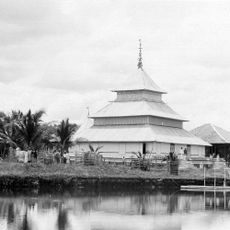
The site was once home to Sultan Thaha Syaifuddin's palace before Dutch colonial forces took control in 1885 and built an administrative center there. The location was later transformed into a mosque and developed into its present form.
Al-Falah means "victory" in Arabic, and the mosque was built without doors or windows so that any Muslim can enter freely for prayer. The ring beneath the large dome carries gilded Qur'anic calligraphy, and a very large copper chandelier hangs in the space below it.
Visitors of all backgrounds are welcome to enter, though respectful attire and behavior are expected in the prayer spaces. Washing facilities are available, and the main areas are accessible for most visitors.
Locals call it the 'Mosque of a Thousand Pillars', though the sources count 232. The columns come in two forms: slender white pillars with three upward tendrils around the outer roof, and copper-clad cylinders supporting the central dome, their wrapping replaced in 2008.
The community of curious travelers
AroundUs brings together thousands of curated places, local tips, and hidden gems, enriched daily by 93,179 contributors worldwide.