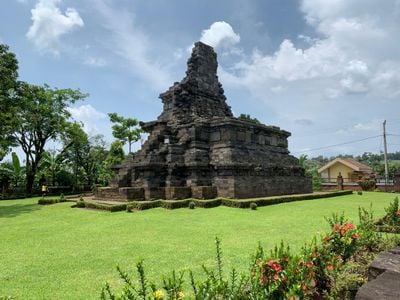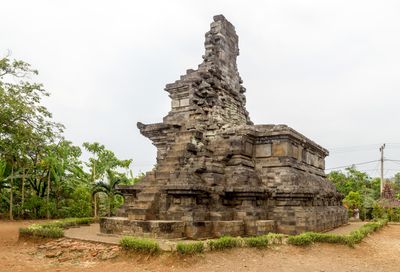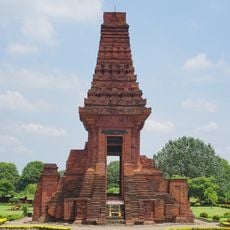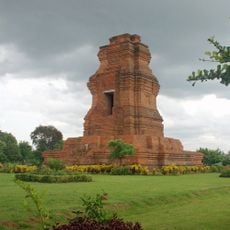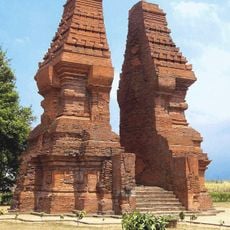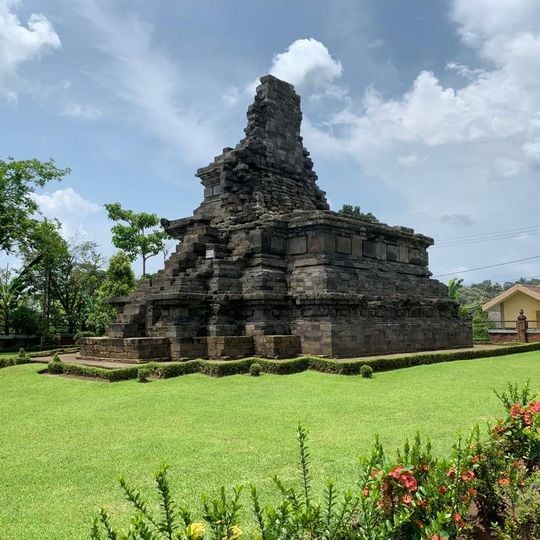
Candi Rimbi, Shaivist Hindu temple in Pulosari, Jombang Regency, Indonesia
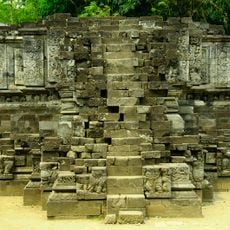
Candi Rimbi is a stone temple near Jombang on the island of Java, built on a stepped base with tiered roofing above its main chamber. The walls on all sides are covered with carved reliefs, and the overall structure follows a compact, vertical design.
The temple was built in the 14th century under the Majapahit Empire, which controlled much of what is now Indonesia. It is believed to have been dedicated to Queen Tribhuwana Tunggadewi, one of the most powerful rulers of that era.
The name comes from Dewi Arimbi, a rakshashi of the Mahabharata; local tradition holds that she and her brother Arimba lie buried in two graves near the temple. The first tier of the base carries 51 reliefs on a water and self-purification theme, including Garuda speaking with his mother Vinata before diving into the sea, alongside geometric patterns, rafflesia flowers and the Majapahit emblem.
The site is in a rural area outside Jombang and is most easily reached by private vehicle or motorbike. Plan enough time to walk around the full perimeter, as the carvings on each side of the structure are worth examining closely.
The name Rimbi comes from Dewi Arimbi, a rakshashi of the Mahabharata; local tradition holds that she and her brother Arimba are buried in two graves near the temple. A 189-centimetre andesite murti of Parvati found at the centre of the temple, thought to represent Queen Tribhuwana, is now in the National Museum of Indonesia.
The community of curious travelers
AroundUs brings together thousands of curated places, local tips, and hidden gems, enriched daily by 92,409 contributors worldwide.