Pura Luhur Batukaru, Hindu sanctuary at Mount Batukaru, Tabanan, Indonesia.
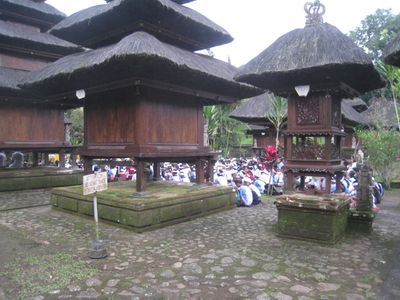
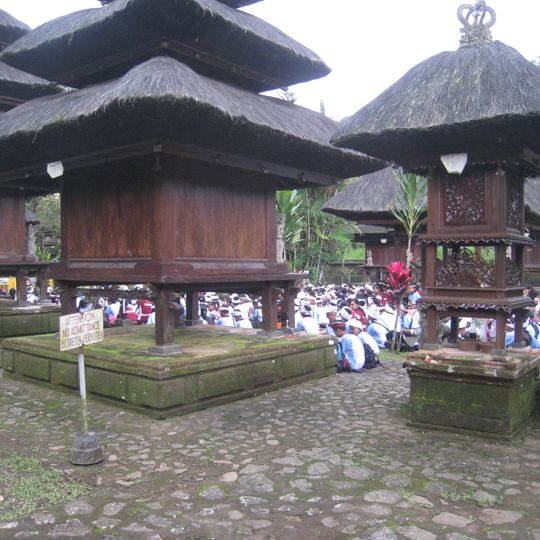
Pura Luhur Batukaru is a Balinese Hindu temple on the southern slope of Mount Batukaru in Tabanan, Bali, Indonesia. Its main shrine is a seven-tiered meru dedicated to Mahadewa, the god of the mountain, and its pelinggih takes the form of a candi rather than a meru, reflecting East Javanese and Indian architecture. A dark wooden pavilion with a pyramidal thatch roof stands on a mossy stone base, and a sign in front reads "ATTENTION / NO ADMITTANCE / STRIKT VERBODEN". East of the main buildings are two springs, one inside the jeroan for holy water and one for bathing before prayer.
The temple was founded in the 11th century as the state sanctuary of the Tabanan royal family. It was destroyed in 1604 and lay in ruin for centuries before being rebuilt in 1959.
Pura Luhur Batukaru honours Sang Hyang Mahadewa as Ratu Hyang Tumuwuh, the god who makes plants grow through the correct use of water. Its piodalan falls every 210 days, on Thursday of the Dungulan week, the day after Galungan. On the east side of the complex two springs rise: the one inside the jeroan supplies tirtha for ceremonies, the outer one is used for bathing and washing the face before praying.
The temple sits far from the main tourist routes and requires a drive along winding mountain roads, so allow extra travel time. Visitors are expected to wear a sarong inside the grounds, and sarongs can usually be borrowed at the entrance.
In 1928 the archaeologist R. Goris studied statues at the temple whose water spouts emerge from the navel, like those at Goa Gajah, but seated cross-legged rather than standing. The main pelinggih is a candi form, not a meru, showing Javanese and Indian influence. The temple's spring is split in two: one part inside the jeroan supplies tirtha for ceremonies, the other serves bathing and face-washing before prayer.
The community of curious travelers
AroundUs brings together thousands of curated places, local tips, and hidden gems, enriched daily by 94,205 contributors worldwide.