Sangeang Api, Active stratovolcano in Lesser Sunda Islands, Indonesia.
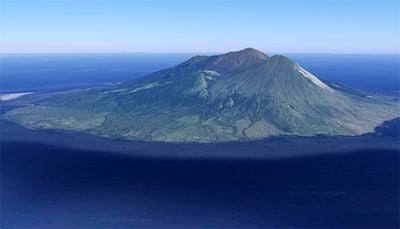
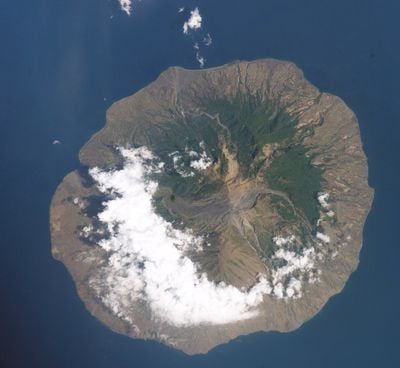
Sangeang Api is a complex volcano on the island of Sangeang, northeast of Sumbawa in the Flores Sea. It has two cones: Doro Api, at 1,949 m, and Doro Mantoi, at 1,795 m. The island is 13 km wide and covers 153 km². Its outer rim is a pale brown ridge scored by gullies; the inner western and northern slopes are green with vegetation, while the eastern and southern slopes are bare grey-brown rock and ash.
Sangeang Api's earliest mention is in the 14th-century Majapahit text Nagarakretagama, which names Sang Hyang Api. Its first recorded eruption came in 1512, and between then and 1989 it erupted 17 times. The 1988 eruption forced the evacuation of the island's inhabitants, and further eruptions followed in December 2012 and May 2014.
The name Sang Hyang Api, meaning "sacred fire," appears in the 14th-century Majapahit text Nagarakretagama. The Bima Regency government officially calls the island Pulau Sangiang, while the mountain is also known as Gunung Api. Johannes V. Jensen named a mountain "Gunung Api" in the first chapter of his novel The Long Journey.
The area requires checking current volcanic alerts before visiting, as the system is highly active. Visitors should coordinate with local authorities and ask about current conditions before approaching the volcano.
The 30 May 2014 eruption sent ash to 15–20 km altitude; by the next morning it had crossed Australia's Kimberley coast, cancelling flights to and from Darwin and later reaching Alice Springs. Some Melbourne and Adelaide flights to Bali were also cancelled on 31 May.
The community of curious travelers
AroundUs brings together thousands of curated places, local tips, and hidden gems, enriched daily by 93,475 contributors worldwide.