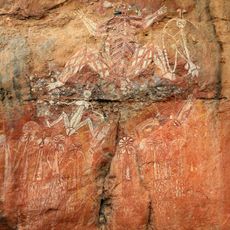
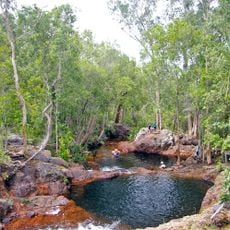
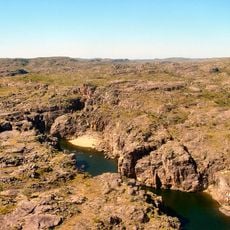
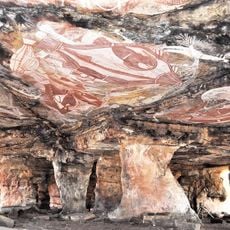
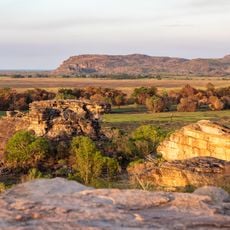
Aboriginal rock painting, Ancient rock art in Kakadu National Park, Australia.
Aboriginal rock paintings are artworks created with natural pigments and charcoal on rock surfaces throughout Kakadu National Park. They feature human figures, geometric designs, and animal depictions that tell stories and represent connections to the landscape.
These artworks were created around 30,000 years ago and rank among the earliest known forms of human artistic expression. Over thousands of years, communities repeatedly renewed and repainted them, layering new designs over older ones.
Aboriginal people link the paintings to the Dreaming, the era in which they believe the works were created. Two styles can be told apart: Mimi figures, drawn in thin red ochre lines like stick figures, and the X-ray style, which shows skeletons and internal organs. The best-known groups lie in Kakadu National Park and at Uluru-Kata Tjuta.
Many sites are accessible through walks of varying length, with access organized through local guides. With interpretation from Aboriginal speakers on site, visitors gain better understanding of the symbols and designs.
Some paintings depict extinct megafauna from the ice age that survives only in these artworks. These depictions offer clues about animals that disappeared long before Europeans arrived.
The community of curious travelers
AroundUs brings together thousands of curated places, local tips, and hidden gems, enriched daily by 94,049 contributors worldwide.