Talgua caves, Archaeological cave system in Catacamas, Honduras.
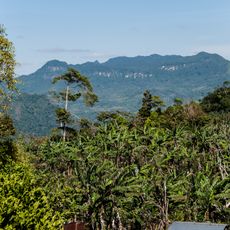
Talgua caves lie in the Olancho Valley, in the municipality of Catacamas, about six kilometres from the city, on the east bank of the Talgua River. The ossuary chamber sits roughly 600 metres inside the cave, and a second tunnel there holds three passageways. Human bones cemented to the floor by calcite and at least 20 ceramic vessels were found in these spaces.
Archaeological investigations in the 1990s uncovered burial sites dating back to 1000 BCE within the chambers. The findings demonstrate that this location served as a burial ground across multiple centuries.
The bones were secondary burials: flesh was removed elsewhere and the bones carried in as small bundles, then painted with red ocher containing iron oxides and hematite, which also splattered the floor and walls. At least 20 restorable ceramic vessels accompanied the dead, one deliberately pierced at the base. A Spanish missionary, Father Fernando Espino, described the Olancho Valley in 1674 as holding more than two hundred nations and languages.
The ossuary chamber lies about 600 metres inside the cave, on the east bank of the Talgua River roughly six kilometres from Catacamas. The bones rest in and around rimstone dams about one metre deep, and those on ledges above the water line have suffered from dripping water and vandalism. Expect a guided visit; the IHAH authorised and supervised all exploration and protection of the cave.
The bones were painted with red ocher made from iron oxides and hematite, and the pigment was also splattered on the ground and walls around the chamber, apparently applied quickly and liberally. Calcite later cemented the remains to the floor. The cave lies on the east bank of the Talgua River, about six kilometres from Catacamas.
The community of curious travelers
AroundUs brings together thousands of curated places, local tips, and hidden gems, enriched daily by 93,997 contributors worldwide.