San Carlos de la Barra Fortress, Colonial fortress in Municipio Almirante Padilla, Venezuela
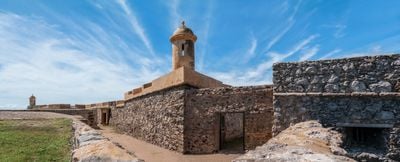
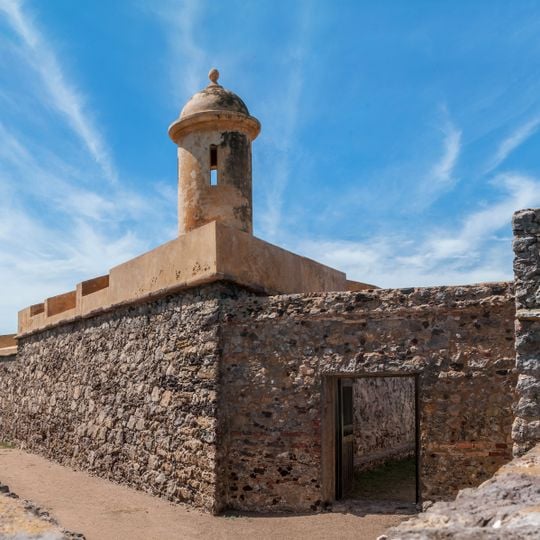
San Carlos de la Barra Fortress is a 17th-century star fort at the entrance to Lake Maracaibo, built in 1623 from limestone brought from Toas Island. Its lower section is a long, thick wall of rough grey and brown stones with a doorway leading into a shadowed passage. Above rises a tan platform with a stepped edge, topped by a cylindrical stone tower with a small dark opening and a rounded dome.
Built in 1623 from limestone brought from Toas Island, the fort guarded the channel linking Lake Maracaibo to the Gulf of Venezuela. In 1666 the pirate El Olonés took it in under three hours with 8 ships and 650 men. In 1823 Admiral José Prudencio Padilla's squadron forced the bar, and in 1903 the fort exchanged fire with the German gunboat SMS Panther, which had run aground.
The fort's name comes from Saint Charles and the sandbar, or barra, at the lake entrance. Its walls are built of limestone blocks brought from Toas Island, a material and construction detail visible in the rough grey and brown masonry. The site is now a National Historical Monument, declared in 1965, and a ferry route connects San Rafael de El Moján with San Carlos island.
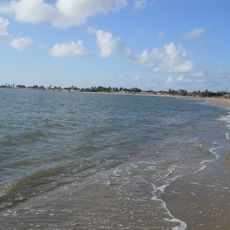
The fort stands on the San Carlos peninsula at the mouth of the Maracaibo bar; a small ferry route runs from a dock at San Rafael de El Moján to the terminal on San Carlos island. The stone surfaces are rough and the ground uneven, so sturdy shoes help. Daylight shows the limestone walls and the water on both sides.
The fortress served a dual purpose as both a military installation and a prison, where poet Eduardo López Bustamante wrote literary works during his confinement. This dual function reveals how places could shift their role over time.
The community of curious travelers
AroundUs brings together thousands of curated places, local tips, and hidden gems, enriched daily by 94,775 contributors worldwide.