Templo y exconvento de San Agustín, Plateresque convent in Atotonilco El Grande, Mexico.
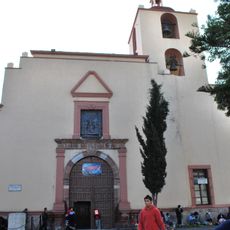
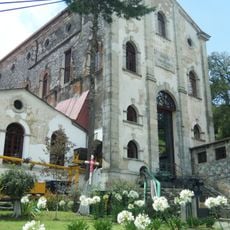
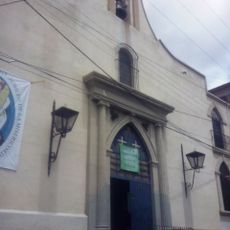
The Templo y exconvento de San Agustín in Atotonilco el Grande is a Plateresque complex built between 1542 and 1562. Its main facade faces east and has three sections: the first with a round arch flanked by paired columns and reliefs of Saint Peter and Saint Paul, the second with six pilasters and a central niche, and the third with a round-arched window topped by a shell-shaped finish. A bell tower from 1850 and a three-opening espadaña rebuilt around 1985 crown the facade. The single nave has a barrel vault, while the narrower apse is covered by a higher ribbed vault with pointed arches. South of the church, the two-level cloister has four round arches on each floor and is decorated with carved spheres known as Gothic pomas.
Fray Alonso de Borja founded the convent in 1536, and it was the first Augustinian construction in Hidalgo. After Borja's death in 1542, Fray Juan de Sevilla began building the current complex, completed in 1562. A 1546 inscription in the nave vaults shows the work was already advanced. It was secularized on 15 November 1754 and became a parish of the Mineral del Monte vicariate.
The cloister's lower level carries a band of plant motifs, and on the east wall a painted Augustinian belt with ring-shaped rolls is shown "like a serpent", a symbol of the celibacy and chastity asked of the order. Carved Gothic spheres, called pomas, decorate bases and cornices. The stairwell frescoes place Saint Augustine among Socrates, Aristotle, Plato, Seneca, Cicero and Pythagoras.
The complex is walkable on foot through its different areas, with open courtyards that give you a clear sense of the layout. Wear comfortable shoes and take time to examine the carved details across the stone surfaces.
The cloister's bases and cornices carry carved stone spheres called pomas góticas, a Gothic ornament rarely found in New Spain. In the lower cloister, a band of plant motifs includes an Augustinian belt painted with rings "like a serpent", a symbol of the order's chastity. Much of the mural painting was uncovered by Luis Sagaón Espinosa in 1951.
The community of curious travelers
AroundUs brings together thousands of curated places, local tips, and hidden gems, enriched daily by 93,764 contributors worldwide.