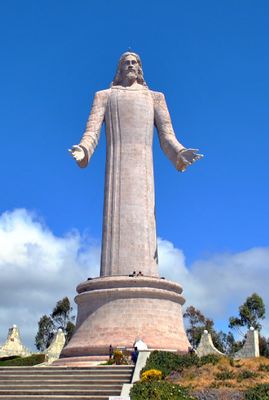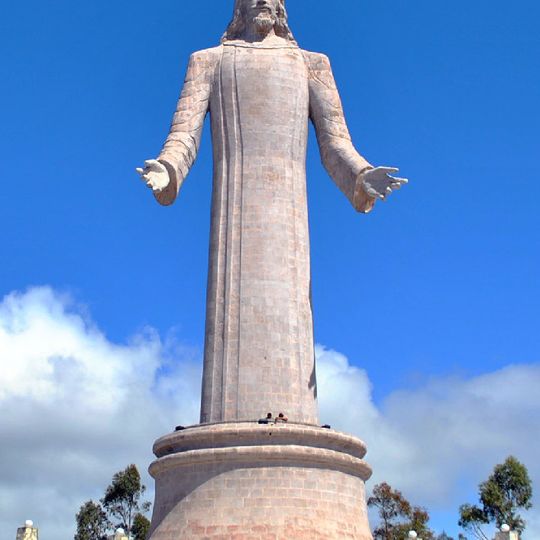
Cristo Rey de Pachuca, Marble statue in Pachuca, Mexico.
Cristo Rey de Pachuca is a 23-metre statue on a 10-metre cylindrical pedestal of stacked stone blocks, set on Santa Apolonia hill. The robed figure has long hair and a beard, arms outstretched with open palms, and a vertical ridge down the robe; the pale beige and pinkish stone is laid in a grid of rectangular blocks. The total height of 33 metres symbolises the age at which Jesus died.
In 1940 about fifteen miners at the Paricutín mine were trapped when the winch jammed; they vowed to build a monument to Christ the King if rescued, and the winch later released. Nearly four decades passed before Father Alfonso Romero Ruiz and retired miners pressed for the vow to be kept. The land was bought on 3 August 1982, a four-metre wooden cross was carried up in 1988, and the statue was inaugurated on 17 April 1996.
The hill is called Santa Apolonia, also known as Cerro del Cristo Rey, and the site is a pilgrimage destination above all during Holy Week and other Catholic feast days. The 33-metre total height is deliberate: it stands for the age at which Jesus died, with 23 metres of sculpture on a 10-metre base.
The statue stands on the summit of Santa Apolonia hill at about 2,665 m above sea level, reached by a path up from Pachuca. The base holds a 180-degree viewing platform over the city. The site is a pilgrimage point above all during Holy Week, when crowds gather for Mass and processions.
The sources record two explanations for the outstretched arms: some call it a gesture of welcome, others say it keeps the strong Pachuca winds from damaging the figure. No document states which was intended, so the design's purpose remains a matter of dispute. The statue is 23 metres tall on a 10-metre base, the 33 metres matching the age at which Jesus died.
The community of curious travelers
AroundUs brings together thousands of curated places, local tips, and hidden gems, enriched daily by 93,870 contributors worldwide.