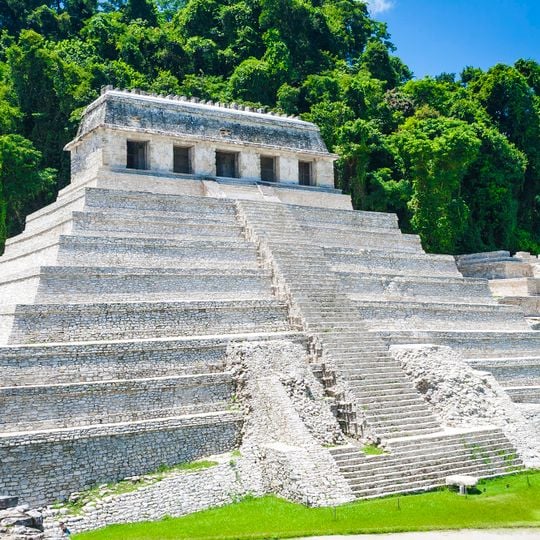
Temple of the Inscriptions, Step pyramid in Palenque, Mexico.
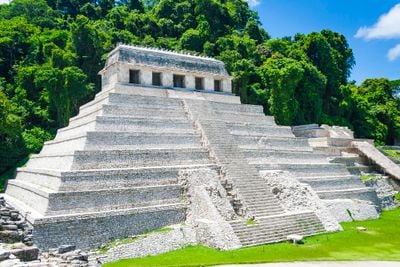
The Temple of the Inscriptions, or Bʼolon Yej Teʼ Naah ("House of the Nine Sharpened Spears"), is a stepped pyramid 22.8 m high with eight stone terraces plus the temple, giving nine levels that symbolize the nine levels of Xibalbá. A broad central stairway climbs the front to a rectangular sanctuary with five dark entrances framed by piers bearing stucco reliefs. Inside, a stairway descends to Pakal's crypt.
Construction began in the last decade of Pakal's life and was completed shortly after 683 by his son K'inich Kan Bahlam II. In 1949 Alberto Ruz Lhuillier removed a floor slab and found a rubble-filled stairway; when cleared in 1952 it led to Pakal's tomb, 1.50 m below the floor.
The temple's name comes from three hieroglyphic tablets on the inner walls, among the longest known Maya inscriptions. They record events in Pakal's life, his death and the naming of Kan Bahlam II as heir, and express the idea that past events repeat on the same calendar date.
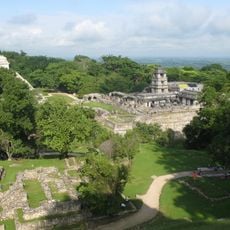
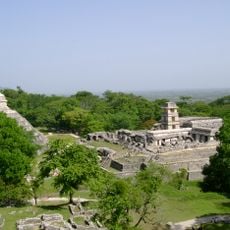
The exterior stairway of the pyramid is closed to visitors, so the temple and Pakal's crypt cannot be reached by climbing it; a reproduction of the crypt and sarcophagus lid is displayed at the National Museum of Anthropology in Mexico City. The structure stands on a naturally sloping hill in the Gran Plaza, at a right angle to the southeast of the Palace.
The temple's name in Classic Maya, Bʼolon Yej Teʼ Naah, means "House of the Nine Sharpened Spears", matching its eight stepped terraces plus the temple on top, nine levels in all. A hollow psychoduct runs from the outer temple down into Pakal's tomb; its stone band has led researchers to compare it to an umbilical cord linking the king to the building.
The community of curious travelers
AroundUs brings together thousands of curated places, local tips, and hidden gems, enriched daily by 93,874 contributors worldwide.