Pariacaca, Sacred mountain in Central Andes, Peru
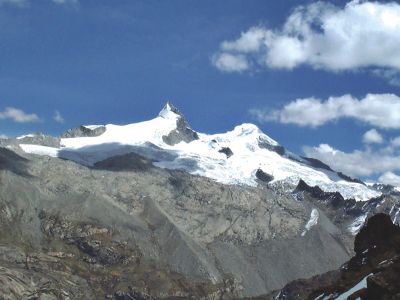
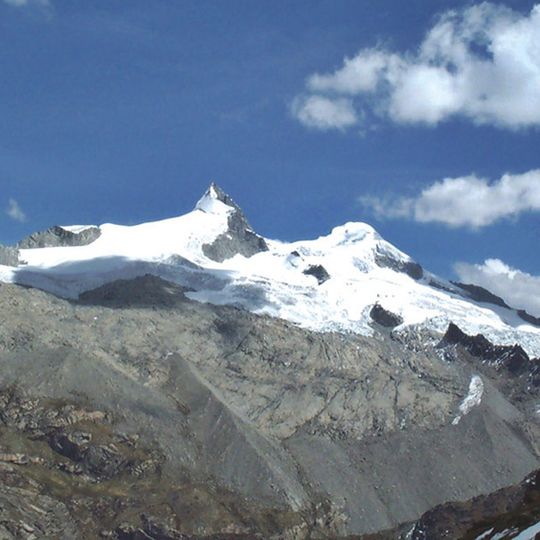
Pariacaca is a mountain on the Junín–Lima border in the Central Andes, with a sharp summit near its centre and a slightly lower rounded peak to the right. The upper half is snow and ice broken by dark rock faces, including a triangular outcrop just left of the highest point; below lie grey and brown rock and scree with deep gullies.
Pariacaca was one of the most important deities of the Tahuantinsuyo, and its shrine was linked to Pachacámac and Cusco by the Inca ceremonial road, part of the Qhapaq Ñan. The 1609 and 1611 Carta Annua describe the cult places at the shrine: the large cave Cuchimachay, a sacrifice site and three small stones. The road was still used in colonial times.
In the Andean worldview Pariacaca was one of the most important deities of Tawantinsuyu, and pilgrims walked the Inca road from the Pachacámac sanctuary near Lima to its shrine. The Huarochirí Manuscript records the deeds of gods and heroes across this sacred landscape. A 1609 church report describes a large cave, Cuchimachay, a sacrifice site and three small stones at the shrine.
Climbing expeditions require extensive preparation and high-altitude experience due to the challenging conditions at this elevation. The best climbing season is between April and October when weather is more stable for safe ascents.
The Quechua name may derive from parya (reddish, copper) and qaqa (rock), while an alternative name, Tullujuto, may mean "bone heap". A Canadian hiker, Nicholas Royer, disappeared in the mountains in 2004.
The community of curious travelers
AroundUs brings together thousands of curated places, local tips, and hidden gems, enriched daily by 94,485 contributors worldwide.