Anticona, Mountain summit in Huarochiri Province, Peru
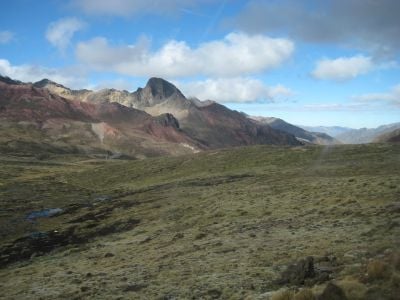
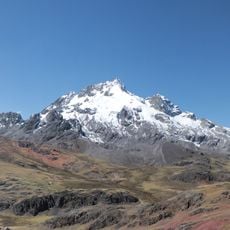
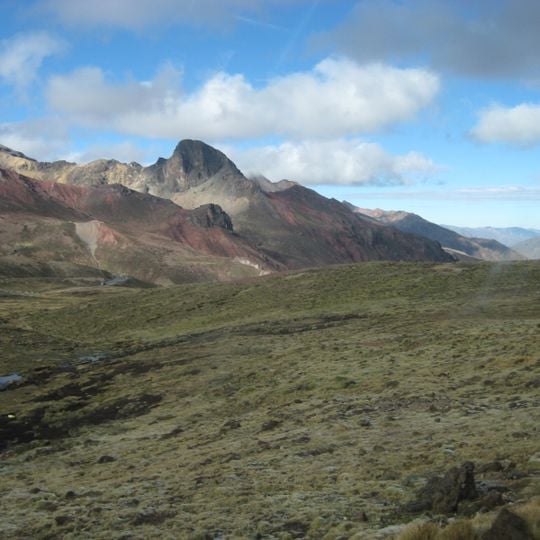
Anticona is a mountain summit in the Peruvian Andes reaching about 5,150 metres, on the border of the Lima and Junín regions. Its upper slopes are bare, banded in reddish-brown, maroon and pale tan rock, with grey outcrops near the sharp dark grey peak and a broad rounded shoulder on the left. Below, the mountain merges into gently sloping grass-covered ground dotted with low vegetation and scattered dark rocks. It lies between the Ticlio mountain pass to the southwest and Yanashinga to the northeast, northwest of a lake called Huacracocha.
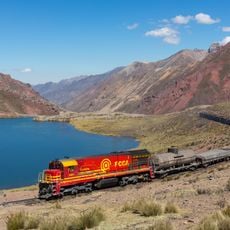
The mountain played a key role in the development of the Ferrocarril Central Andino, a railway line built in the second half of the 1800s. This ambitious project surpassed all other rail installations of its time in elevation and technical complexity.
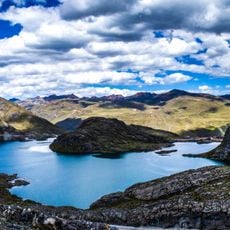
Anticona's name may derive from Quechua words for metals, minerals, or rainforest inhabitants. The mountain sits between the Ticlio pass and Yanashinga, near Huacracocha lake, and its summit area is associated with the Ernest Malinowski Monument honouring the engineer of the Ferrocarril Central Andino.
Visitors should acclimatize to the altitude since atmospheric pressure drops to roughly half that of sea level, which can cause headaches and breathing difficulties. Climbing slowly and allowing time for your body to adjust is wise, especially if coming from lower elevations.
Anticona's name may derive from Quechua words for metals or minerals, or for the inhabitants of the rainforest or the Andes. The mountain lies between the Ticlio pass to the southwest and Yanashinga to the northeast, northwest of a lake called Huacracocha. Its slopes are banded in reddish-brown, maroon and pale tan rock above grass-covered ground.
The community of curious travelers
AroundUs brings together thousands of curated places, local tips, and hidden gems, enriched daily by 93,582 contributors worldwide.