Cape Mendocino, Westernmost cape on the California coast, United States.
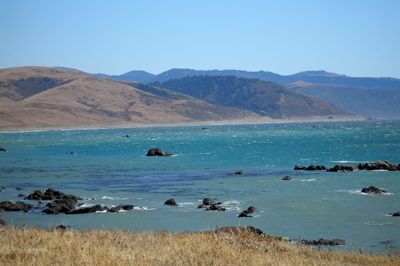
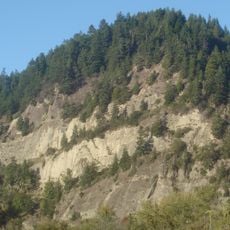
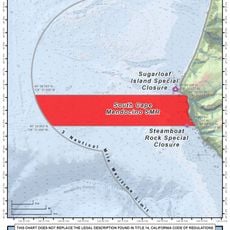
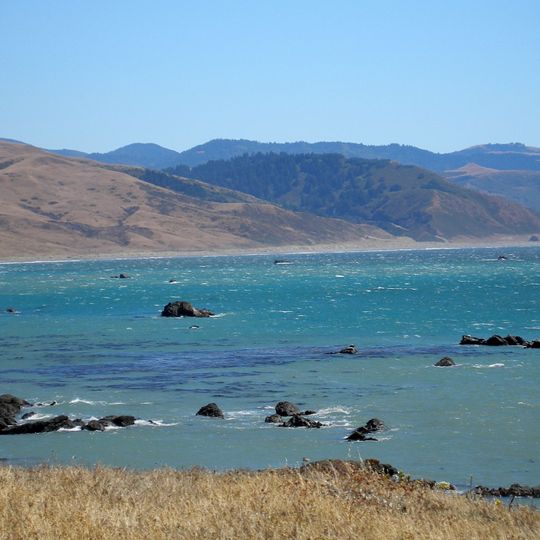
Cape Mendocino is a broad, low headland on the Lost Coast of Humboldt County, California, and the westernmost point on the state's coastline. Dry tan grass covers its lower slopes, dense dark green trees stand on its upper and central sections, and a narrow strip of pale sand or shingle runs along the water at its base. The landform reaches from the left toward the centre-right, where a smaller rise of similar colour meets it before the view opens to the sea.
Spanish navigators discovered and named the cape in the 16th century after Antonio de Mendoza, the Viceroy of New Spain. The name preserves the memory of this early European exploration of the California coast.
Spanish navigators named the cape Cabo Mendocino for Antonio de Mendoza y Pacheco, the first viceroy of New Spain, who sponsored the 1542 expedition that sighted it. Manila galleons later used it as a landfall after crossing the Pacific, then sailed south along the coast to Acapulco.
The area is popular with hikers but has few amenities and requires good preparation. Waterproof clothing and sturdy footwear are recommended, as weather can change quickly and trails can be demanding.
The location sits at the Mendocino Triple Junction, where three tectonic plates meet, creating one of California's most seismically active zones. This geological feature shapes the dramatic landscape that visitors see today.
The community of curious travelers
AroundUs brings together thousands of curated places, local tips, and hidden gems, enriched daily by 92,854 contributors worldwide.