Battery Point Light, Integral lighthouse in Crescent City, California, United States
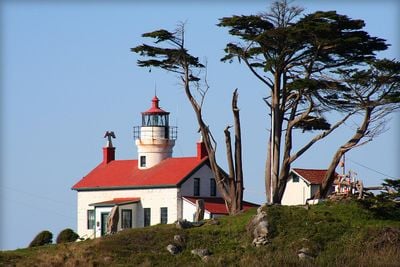
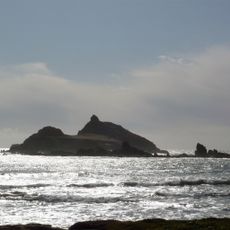
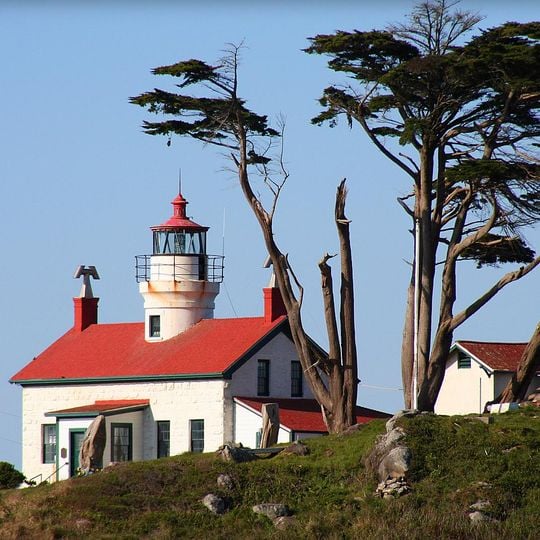
Battery Point Light is a lighthouse on a small islet off Crescent City, California, connected to shore by a tombolo exposed at low tide. The white, one-story keeper's house has a red roof, two brick chimneys and a green-trimmed door under a small porch. Its cylindrical tower rises at the left end, topped by a red lantern room with a red dome and black gallery railing; the tower measures 14 m.
Congress set aside $15,000 in 1855 to build a lighthouse on the islet, and the fourth-order Fresnel lens was first lit in 1856. Theophilis Magruder served as the station's first keeper. The light was automated in 1953, with Wayne Piland as the last keeper, and after being dark from 1965 it was relit in 1982 as a private aid to navigation.
The Del Norte Historical Society runs the keeper's quarters as a museum, furnished with period pieces and artifacts dating from the 1850s, alongside maritime objects, photographs and historical documents. Tours include a climb into the light tower. Two novels are set here: Susan Fletcher's Walk Across the Sea (2001) and Colleen Coble's The Lightkeeper's Daughter (2010).
The isthmus to the lighthouse is walkable only at low tide, and the water rises quickly, so check tide tables before setting out. Tours run daily 10 AM to 4 PM from April through September, and weekends 10 AM to 4 PM from October through March. The crossing is rocky and can be slippery when wet.
When a tsunami from the 1964 Alaska earthquake struck the city, the lighthouse on its rocky base remained unharmed while the town suffered severe destruction. The structure stood untouched as the massive wave swept through the area, sparing it completely from damage.
The community of curious travelers
AroundUs brings together thousands of curated places, local tips, and hidden gems, enriched daily by 92,818 contributors worldwide.