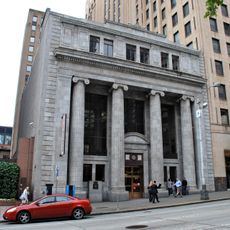
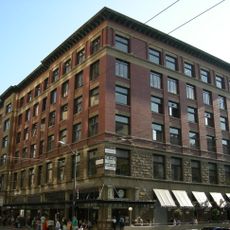
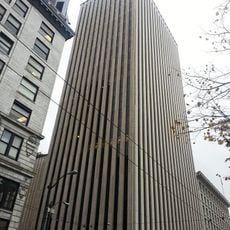
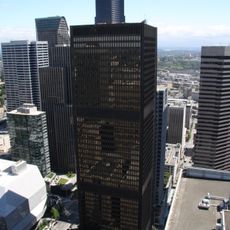
Henry M. Jackson Federal Building, Federal office skyscraper in Downtown Seattle, United States.
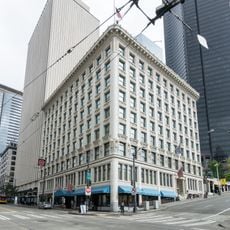
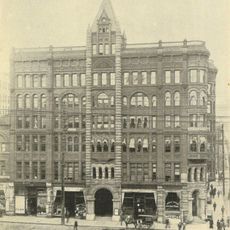
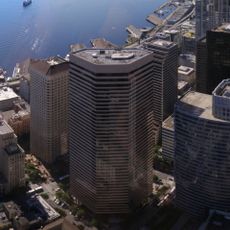
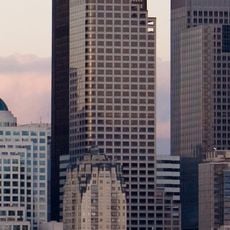
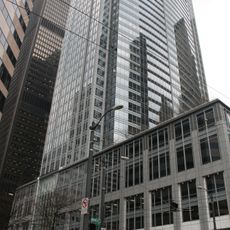
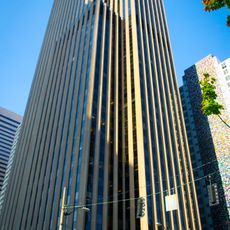
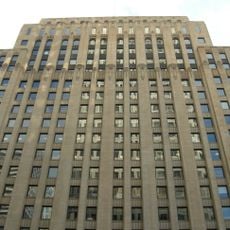
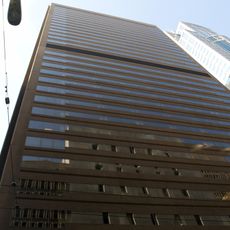
The Henry M. Jackson Federal Building is a 37-story tower on the block bounded by First and Second Avenues and Madison and Marion Streets in downtown Seattle. Its square footprint has clipped corners, a steel frame clad in precast concrete with recessed windows, and a metal-clad hipped roof. Arched arcades echo the Romanesque Burke Building that once stood on the site.
Construction began in 1971 and finished in 1974, replacing the Richardsonian Romanesque Burke Building (1889–91), the Hotel Stevens and the Rivoli Theater. Preservationists fought the 1971 demolition, so the architects reused the Burke's Romanesque entry arch in the Second Avenue plaza. The tower was renamed in 1984 for Senator Henry M. "Scoop" Jackson (1912–1983), author of the National Environmental Policy Act of 1969.
Three sculptures stand on the stepped brick plaza along Second Avenue. Isamu Noguchi's Landscape of Time (1975) is a five-part grouping carved from pink Japanese granite boulders; Harold Balazs made the welded copper Seattle Project (1976), and Philip McCracken's cast-bronze Freedom (1976) shows a bird breaking free of its cage.
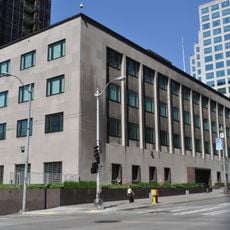
The building fills the block between First and Second Avenues and Madison and Marion Streets, across from the Old Federal Building. The site slopes toward Elliott Bay, so the Second Avenue plaza steps down toward First Avenue in brick terraces with seating. The plaza and its sculptures can be seen from the street; offices require screening.
When the earlier Burke Building was demolished in 1971, selected elements were salvaged and incorporated into the cafeteria of this structure. These architectural fragments link the newer building to Seattle's previous urban past.
The community of curious travelers
AroundUs brings together thousands of curated places, local tips, and hidden gems, enriched daily by 94,483 contributors worldwide.