Giant Springs, Natural spring and state park in Great Falls, Montana
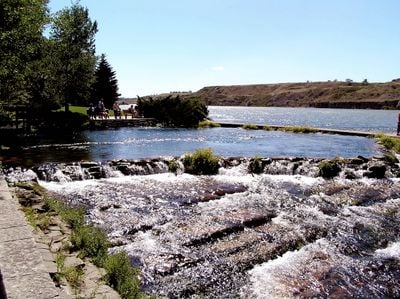
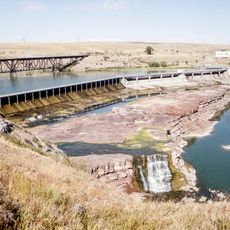
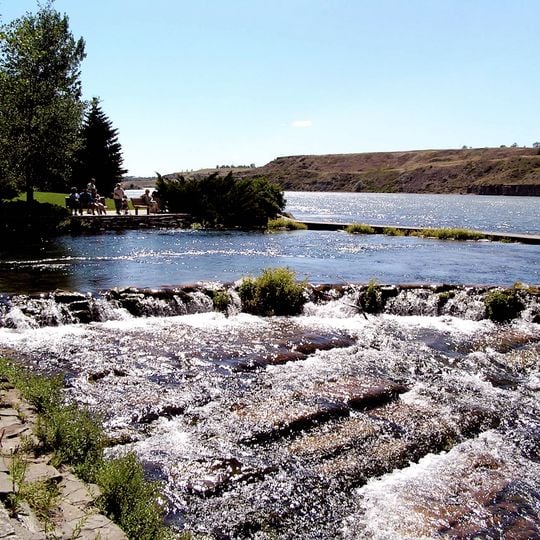
Giant Springs is a first-magnitude spring on the east bank of the Missouri River just downstream and northeast of Great Falls, Montana. Its water emerges at a constant 54 °F (12 °C) from an opening in the Madison Limestone and averages 242 cubic feet (6.9 m³) per second, or 150 million gallons a day. The outlet feeds a broad pool that spills over a wide, stepped ledge of dark, irregular rock in white foam, with a concrete walkway and a tree at the water's edge beyond.
The spring was documented by the Lewis and Clark Expedition in 1805, with William Clark noting it as the largest fountain he had ever encountered. This early exploration made Giant Springs a notable landmark in the mapping of the American West.
The Blackfeet used the springs as an easily reached water source in winter, before Lewis and Clark described them in 1805. After Great Falls was founded in 1884, the springs became a Sunday recreation spot for townspeople. Water from the spring still feeds the Giant Springs Trout Hatchery, which raises mostly rainbow trout.
The spring outlet and its pool sit on the east bank of the Missouri River, just downstream and northeast of Great Falls, reached by a flat concrete walkway along the water. The 200-foot Roe River runs from the spring into the Missouri beside the park. Much of the flow is diverted to the Giant Springs Trout Hatchery, so expect hatchery raceways near the spring.
The spring forms the headwaters of the Roe River, which runs only about 200 feet (61 m) to the Missouri River and was listed by Guinness World Records as the world's shortest river until the category was retired in 2006.
The community of curious travelers
AroundUs brings together thousands of curated places, local tips, and hidden gems, enriched daily by 93,361 contributors worldwide.