11th Street Bridge, Concrete arch road bridge in Tulsa, United States
The 11th Street Bridge is a concrete road bridge in Tulsa that crosses the Arkansas River. The structure consists of 18 spans supported by piers anchored deep into bedrock.
Completed in December 1915, the 11th Street Bridge replaced an earlier wooden structure and was the first bridge built to carry automobiles across the Arkansas River. Engineered by Harrington, Howard and Ash of Kansas City and built by the Missouri Valley Bridge and Iron Company for $180,000, it was Oklahoma's first multi-span concrete bridge. It carried Route 66 traffic from 1916 until 1972.
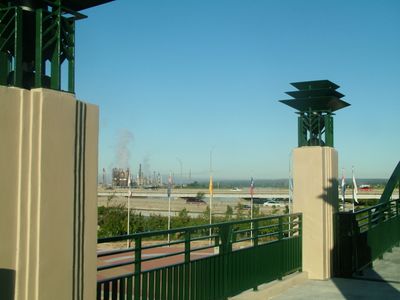
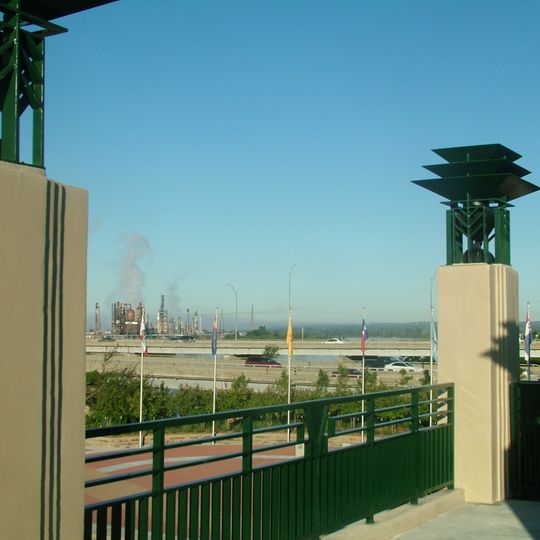
The bridge's ability to reuse an existing Arkansas River crossing was cited as the main reason U.S. Route 66 was routed through Tulsa. In 2004 the city renamed it the Cyrus Avery Route 66 Memorial Bridge, honoring the man who promoted the highway's creation. Nearby, the Cyrus Avery Centennial Plaza displays flags of the eight Route 66 states and Robert Summers's bronze "East Meets West", showing the Avery family in a Model T meeting a horse-drawn carriage.
The bridge has been closed to vehicles since 1980 and its gates were locked in 2008, so it cannot be crossed on foot either. The deck has holes, buckled pavement and weeds in the cracks, and Tulsa rates it unsafe for pedestrians. Views of the structure are best had from the adjacent Cyrus Avery Centennial Plaza and its skyway observation deck.
The bridge's 1929 Art Deco guardrails and lights replaced the original Victorian balustrades. A 1934 project added a second arched span downstream, joined to the first by a single deck that widened the crossing to 52 feet 8 inches and four traffic lanes.
The community of curious travelers
AroundUs brings together thousands of curated places, local tips, and hidden gems, enriched daily by 93,783 contributors worldwide.