Great Mosque of Sumenep, 18th-century mosque in Sumenep, Indonesia
The Great Mosque of Sumenep has a three-tiered main roof topped with a kemuncak ornament of three spheres, surrounded by six smaller two-tiered roofs to the south, east and north. White brick walls enclose the prayer hall, whose tall windows and main door are painted in bold colours. Two small cupola pavilions flank the eastern perimeter.
Construction ran from 1779 to 1787 under Panembahan Somala, 31st adipati of Sumenep, as part of the kraton complex. Its architect, Lauw Pia Ngo, had already completed the palace in 1764. It replaced masjid laju, the old mosque finished in 1757 under the 21st ruler, Kanjeng Raden Tumenggung Aria Anggadipa. In 1806 Somala's son, Prince Abdurrachman Tirtodiningrat, had the mosque recorded as inalienable waqf.
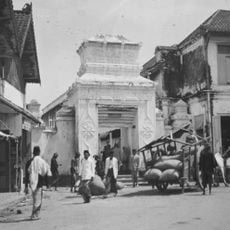
The main gate is a gapura, from the Arabic ghafura, "place of forgiveness". Its carvings carry the founder's hopes for worshippers: two openings as watching eyes, two arched side doors as ears, and a chain ornament urging Muslims to keep their bonds unbroken. A bedug drum hangs above the portal; it came from the earlier masjid laju.
The main gate faces the alun-alun; two staircases on its left and right lead up to a platform above the portal, where the bedug drum hangs. Two small cupola pavilions flank the eastern perimeter, at the southeast and northeast corners. The compound is enclosed by an iron fence, replacing the massive wall of earlier times.
Two small pavilions with rounded cupolas at the southeast and northeast corners were once used as prison cells within the grounds. This unexpected use reveals how the site historically served as a center of authority and administration.
The community of curious travelers
AroundUs brings together thousands of curated places, local tips, and hidden gems, enriched daily by 92,865 contributors worldwide.