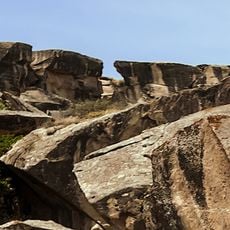
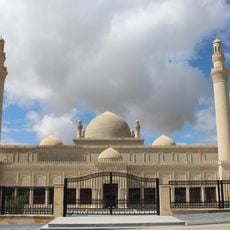
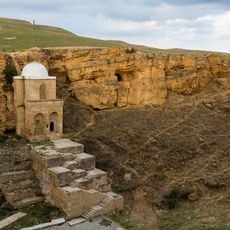
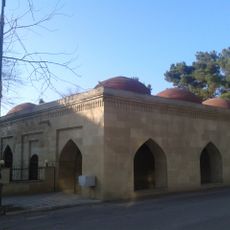
Pir Huseyn Khanqah, Medieval fortress in Hajigabul District, Azerbaijan.
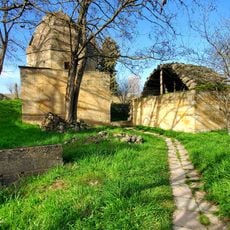
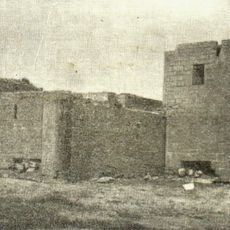
Pir Huseyn Khanqah is a medieval fortress in Hajigabul with a rectangular layout and open courtyard surrounded by defensive walls. It features round bastions at its corners and semicircular bastions positioned along the perimeter for protection.
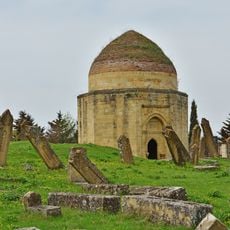
The complex grew from the tomb of Sheikh Pir Huseyn Shirvani, who died in 1074. The entrance gate bears a construction date of 1243, and the minaret inscription records that master Mahmud Maqsud oglu built it in 1256. The tomb's tiles were made by Umar Muhammad oglu Qazvini in 1285–1286.
The site is named after Sheikh Pir Huseyn Shirvani, whose tomb, rebuilt by Umar ibn Muhammad al-Qazvini in 684 AH (1285–1286), stands beside the mosque. The mihrab's carved gypsum panels with turquoise tile inserts were moved to Baku's Nizami Museum for protection. The minaret bears the name of its builder, ustad Mahmud Maqsud oglu, and the date 1256.
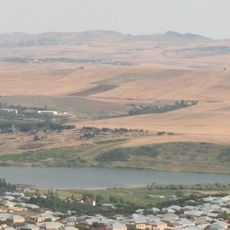
The khanqah stands near the village of Qubalıbalaoğlan in Hajigabul District, on the left bank of the Pirsaat River about 126 km southwest of Baku. Only the mosque, the tomb of Pir Huseyn and the minaret survive in good condition; the four fortress walls, corner towers and the stable outside the walls are fragmentary. The minaret is roughly 17 m high with a spiral stair inside. The carved gypsum mihrab was moved to the Nizami Museum in Baku, so look for it there rather than in the mosque.
Inside the walls were over four hundred glazed tiles decorated with images of birds, horses, and fish on turquoise backgrounds. These precious tiles have been carefully preserved and are displayed in museums today.
The community of curious travelers
AroundUs brings together thousands of curated places, local tips, and hidden gems, enriched daily by 93,712 contributors worldwide.