Red Church, Byzantine basilica in Perushtitsa, Bulgaria
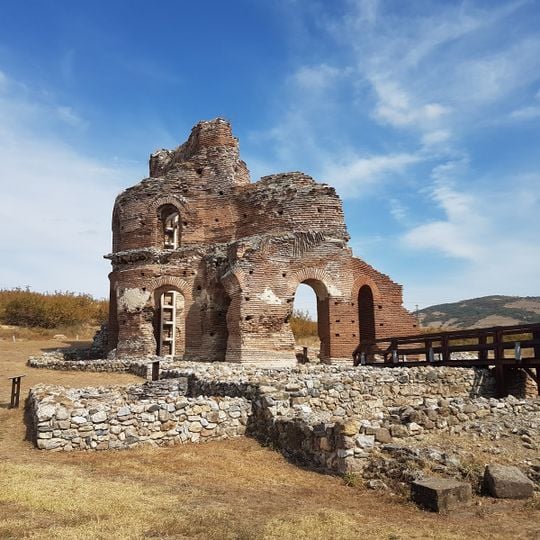
The Red Church is a ruined late Roman basilica near Perushtitsa, built of red brick and pink mortar under Emperor Anastasius I (491–518). Its central hall is a four-conch space with semi-domed niches, and the best-preserved north wall reaches about 14 m. The original building measured 32.70 by 25.90 m and had a narthex, an exonarthex, a baptistery with a pink marble piscina, and a chapel.
The structure was built in the late 5th century under Emperor Anastasius I and functioned as a sacred building for storing the remains of martyrs. Over centuries it remained at this location, eventually becoming an archaeological testimony to early Byzantine religious practice.
The name comes from the red Roman bricks and pink mortar, not from any religious meaning. The church was dedicated to the Virgin Mary, and tradition holds it later served as a summer residence for Byzantine nobles. Two fresco layers survive from between the 6th and 11th centuries; some are kept in Sofia's National Historical Museum and Perushtitsa's history museum.
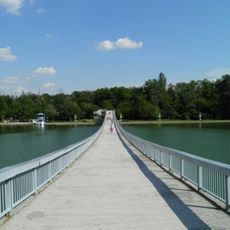
The ruins lie about a kilometre from Perushtitsa, at the foot of the Rhodopes and roughly 20 km southwest of Plovdiv. A 700 m pedestrian alley leads to the site from a small car park left of the main road, with a sign at the turn-off. A visitor centre stands by the ruins, which were reopened on 19 April 2013 after conservation.
The freshwater spring beneath the church is linked to a Mithraic legend: a stone pierced along its length still lets water flow from its core, recalling the god Mithras striking rock with an arrow. A fresco of Mithras reborn from a red egg survived here even after the site became Christian.
The community of curious travelers
AroundUs brings together thousands of curated places, local tips, and hidden gems, enriched daily by 93,537 contributors worldwide.