St. Paul's Cathedral, Catholic cathedral in Plateau district, Abidjan, Côte d'Ivoire
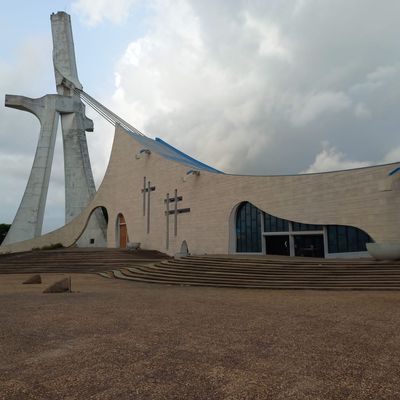
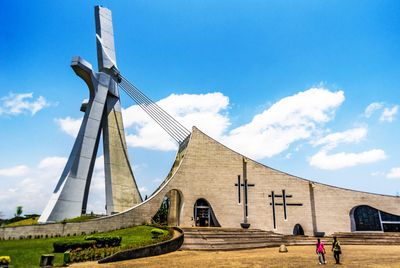
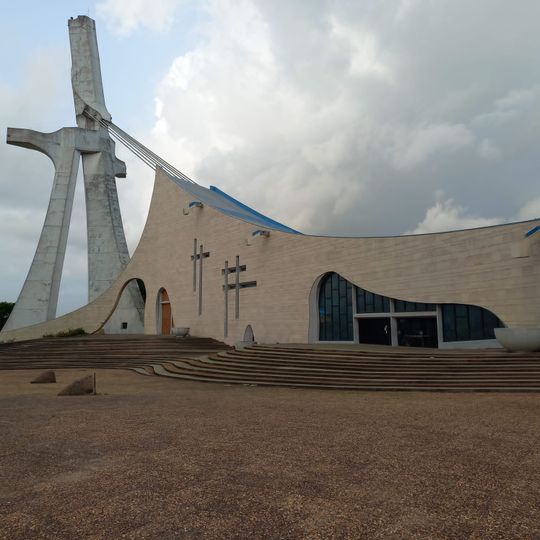
St. Paul's Cathedral is a triangular concrete building of 4,200 m² on a hillock above the Bay of Cocody, designed by Italian architect Aldo Spirito. Three bell towers support the roof through seven steel cables, and the central tower rises into a 70-metre cross. Its side walls extend into elephant-tusk shapes that wrap around the towers.
The foundation stone was laid by Pope John Paul II in 1980, and the completed building received papal dedication in 1985 during his second visit to Côte d'Ivoire. These two visits established it as a symbol of the country's religious importance to the wider world.
The fourteen polychrome terracotta panels are fixed on the exterior wall of the steps leading from the lagoon to the forecourt, not inside; they follow the story of Christ in sequence, shaped by local ethnic readings. Inside, twelve polychrome ceramic panels and mosaics of the Sacraments carry the same local framing.
The cathedral stands on a hillock above the Bay of Cocody, reached by a long stairway whose side wall carries the fourteen terracotta panels of the Stations of the Cross; the garden Way of the Cross itself has 300 steps. Allow time for the climb and for the slope between the lagoon side and the forecourt. It remains an active place of worship, so keep quiet during services.
During the 2010-2011 political crisis, the building sheltered roughly 1,800 people seeking safety from the violence unfolding across the city. This unexpected humanitarian role demonstrates how religious sites can become places of hope and protection during times of unrest.
The community of curious travelers
AroundUs brings together thousands of curated places, local tips, and hidden gems, enriched daily by 92,770 contributors worldwide.