Nanpu Bridge, Cable-stayed bridge in Shanghai, China
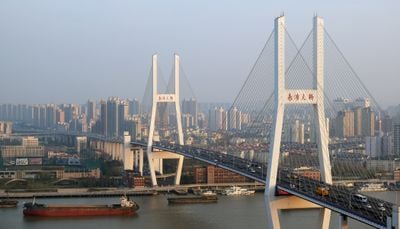
Nanpu Bridge is a cable-stayed bridge over the Huangpu River between Huangpu District and Pudong. Its deck is 846 metres long and 30.35 metres wide, carrying six lanes, with a main span of 423 metres cleared in one jump over the water. Two reinforced concrete pylons rise 150 metres, each shaped as a bent H with 22 pairs of cables per side and red characters reading 南浦大桥 on the crossbeams.
Construction began in 1988 and finished in 1991, marking one of the first major crossings over the Huangpu River during Shanghai's rapid expansion phase. This connection proved crucial for opening up the Pudong area and linking previously separated districts.
The name comes from the Nanmatou area, where both ends of the bridge stand. The four characters 南浦大桥 on the tower crossbeams are in Deng Xiaoping's own handwriting. Four vertical lifts once carried visitors up to the 2 m walkways, but they stopped operating after 2010, leaving the paid viewing walkways little used.
The bridge carries only motor vehicles around the clock; pedestrians and cyclists are not allowed on the deck and cross the Huangpu by ferry instead. Two-metre walkways exist on both sides of the main span, but the four vertical lifts serving them stopped running after 2010. Views are best had from the banks or from a bus crossing the span.
The Puxi approach ramp loops through a double spiral 180 metres across and 7.5 km long, listed as the largest of its kind in the world. The bridge's name comes from the Nandu pier area at both ends, and its original name was Nandu Huangpu River Bridge.
The community of curious travelers
AroundUs brings together thousands of curated places, local tips, and hidden gems, enriched daily by 92,790 contributors worldwide.