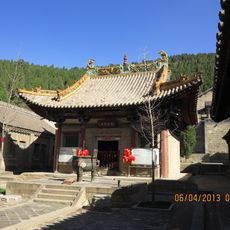
Pagoda of Xiuding Temple, Buddhist pagoda at Qingliang Mountain, Anyang County, China
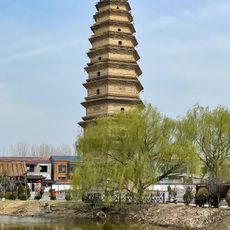
The Pagoda of Xiuding Temple is a single-storey square brick pagoda about 20 metres high, with an octagonal base and a hollow centre; its south face opens through an arched door. Its four walls are clad in 3,775 relief-carved bricks in 72 patterns, covering more than 300 square metres, and each wall is composed as a complete curtain design.
The temple was founded in 494 as Tiancheng Temple, renamed Heshui under the Northern Qi, destroyed under Northern Zhou, and rebuilt in the Sui as Xiuding Chan Temple. The surviving single-storey brick pagoda is Tang: a 758 inscription and a 870 inscription set its date, and thermoluminescence dated the carved bricks to about 1300 years ago. The temple was abandoned in the late Qing.
The carved bricks on the walls show Buddhist figures, Chinese symbols, and dancers from different ethnic groups, reflecting how open the Tang Dynasty was to many cultures. Walking around the base, you notice how these images tell stories of exchange and connection between different peoples.
Visit early in the morning when sunlight hits the carved bricks clearly, making details easier to see. Reaching this mountain location requires traveling by your own transport or joining a local tour, as public options are limited.
The outer walls use specially shaped bricks arranged into squares, diamonds, pentagons, and triangles to create geometric patterns. This brick puzzle reveals how Tang builders used complex masonry techniques to turn their tower into a work of mathematical design.
The community of curious travelers
AroundUs brings together thousands of curated places, local tips, and hidden gems, enriched daily by 94,030 contributors worldwide.