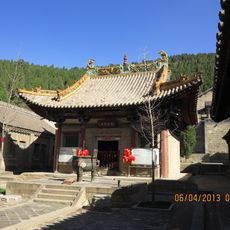
Xiaonanhai Grottoes, Buddhist cave temples in Anyang County, China
The Xiaonanhai Grottoes are three small Buddhist caves cut into the southern foot of Guigai Mountain at Shanying village, Shanying town, Anyang County, Henan. The West Cave opens west and measures 1.76 m high, 1.36 m wide and 1.76 m deep; the Middle Cave faces south at 1.78 by 1.19 by 1.34 m; the East Cave, moved in 1999 to 8 m east of the Middle Cave, is 1.79 by 1.3 by 1.2 m.
The three caves were cut during the Tianbao era of the Northern Qi dynasty (550–559), on the south slope of Guigai Mountain in Shanying village, Shanying town, Anyang County, Henan. Their style resembles that of the Xiangtangshan grottoes in Handan, Hebei. The site was listed as a Henan provincial cultural relic in 1963 and as a Major Historical and Cultural Site Protected at the National Level (fifth batch) in 2001.
The name Xiaonanhai, "Little South Sea", comes from the spring-fed pool south of the Guigai hill where the caves sit; the site is also called Lingshan Temple Grottoes. The three Northern Qi chambers, carved under the Tianbao reign, are small shrines rather than a large monastic complex, and their style follows the Xiangtangshan caves of Handan in Hebei.
The three caves stand close together: the West Cave faces west, the Middle Cave faces south, and the East Cave, moved here in 1999, sits 8 m east of the Middle Cave. All are small, roughly 1.2–1.8 m in each dimension, so only a few people fit inside at once. The site lies at the southern foot of Guigai Mountain by Shan Ying village, a hill's width from Lingquan Temple Grottoes.
The East Cave originally stood about 500 metres east of the Middle Cave; in 1999 it was moved to a spot 8 metres east of it. The three caves were dug in the Tianbao era of the Northern Qi, and their style resembles the Xiangtangshan Grottoes in Handan, Hebei.
The community of curious travelers
AroundUs brings together thousands of curated places, local tips, and hidden gems, enriched daily by 93,862 contributors worldwide.