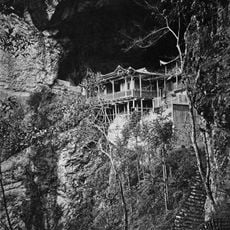
Sakya Script Pagoda, Stone pagoda in Putian, China
The Sakya Script Pagoda is a multi-tiered stone structure in Putian's temple district, built with traditional Chinese architectural forms and Buddhist design elements. The building combines stacked sections with ornamental details that reflect the religious craftsmanship of earlier periods.
The pagoda was built before 1165, during the Southern Song dynasty; its earliest stone inscription, on the right door pillar of the second storey's rear gate, gives that year as the latest possible date. A relic pagoda once stood on the same spot, but neither its construction nor its demolition date is known. The first storey's relief Buddhas were damaged before 1949, and the tower was surveyed and repaired in 1961, 1979 and 1983. It was listed as a Fujian provincial heritage site in 1961 and a national one in 1988.
The pagoda stands east of the Guanghua Temple and is also called the Guanghua Temple Pagoda. Its name plaque, reading Shijiawen Fogong, is set above the south door of the second storey. Reliefs of arhats and Buddhas in varied poses on the facades are studied as material on Southern Song Buddhist art.
The pagoda stands east of the Guanghua Temple at the southern foot of Fenghuang Mountain in Putian's Chengxiang District. A six-step stair on the south side of the 80 cm Xumi base leads up to a 78 cm stone balustrade. Inside, stairs from the northeast and southwest of the ground-floor chamber climb to the top level.
The pagoda has survived typhoons and earthquakes without damage since its completion, according to German Wikipedia. Its earliest dated stone inscription, on the right doorpost of the rear gate on the second storey, sets the latest possible construction date at 1165, before the Southern Song Qiandao era.
The community of curious travelers
AroundUs brings together thousands of curated places, local tips, and hidden gems, enriched daily by 94,019 contributors worldwide.