Mount Qingyuan, Mountain summit in Fengze District, China.
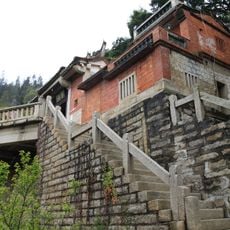
Mount Qingyuan is a granite hill about 3 km north of Quanzhou, its main peak reaching 618 m, within a 62 km2 national park that also takes in Mount Ling and Mount Jiuri. Its slopes hold nine Song and Yuan stone sculptures, some 700 cliff inscriptions and several Yuan and Ming granite chambers built to imitate timber halls.
Mount Qingyuan's earliest mention dates to around 221–207 BCE, and development began in earnest during 618–1279 CE, peaking between 1297 and 1911. The Quanzhou Prefecture Gazetteer records first development in the Qin dynasty, revival under the Tang and a height in the Song and Yuan. In 2021 the wind-praying inscriptions on Mount Jiuri, part of the park, entered the UNESCO World Heritage List.
The mountain's name, Qingyuan, means "clear source", and it is also called Quanshan ("spring mountain") for its many springs. Its stone works include the Four Superlatives: the Laozi statue, the Buddha for Three Lives, the Islamic holy tombs, and the wind-praying inscriptions on Mount Jiuri, added to the UNESCO World Heritage List in 2021.
Mount Qingyuan National Park covers 62 km2 across three areas: the namesake mountain, Mount Ling and Mount Jiuri. The summit stands 498 m above sea level, about 3 km from Quanzhou, and the main scenic peak reaches 618 m. The park is bordered on three sides by the city, 106 km from Xiamen and 196 km from Fuzhou.
A Song Dynasty statue of Laozi was carved directly into the stone face of the mountain and stands as one of the largest sculptures of its kind in the region. This work reveals the craftsmanship of past dynasties and draws visitors interested in traditional stone carving techniques.
The community of curious travelers
AroundUs brings together thousands of curated places, local tips, and hidden gems, enriched daily by 93,801 contributors worldwide.