Chengtian Temple, Buddhist temple in Licheng District, Quanzhou, China.
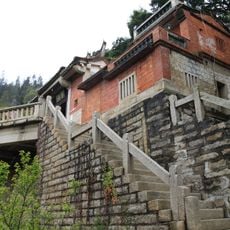
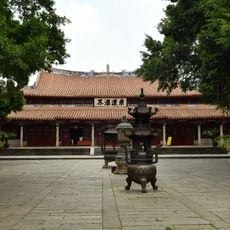
Chengtian Temple is a Buddhist temple in Licheng District, Quanzhou, covering over seventy mu. It faces south, with the Four Heavenly Kings Hall, Maitreya Hall, Free Life Pond, Mahavira Hall, Dharma Hall and Manjushri Hall along its central axis, flanked by bell and drum towers and corridors. The Mahavira Hall has five bays, double-eaves gable and hip roofs, and swallowtail ridges in Minnan style.
Chengtian Temple was first built between 957 and 958 as South Chan Temple on the South Garden of Liu Congxiao, Prince of Jinjiang and Jiedushi of Qingyuan Circuit. In 1007 Emperor Zhenzong of Song bestowed the name Chengtian Temple. It was destroyed in the late Ming and rebuilt in 1691 under Kangxi. In 1966 Red Guards destroyed the Hall of Maitreya, Dharma Hall, bell and drum towers, corridors and pagodas; Chan master Hongchuan began restoration in 1985, completed in October 1990.
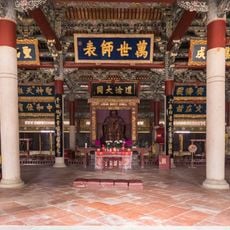
The temple holds significant standing as one of the city's three principal Buddhist sanctuaries and attracts visitors engaged in prayer and meditation. Inside, you will find incense-filled halls with statues that receive regular offerings from devotees throughout the day.
The temple faces south, with its entrance gate on the west side opening onto a passage that leads east to the Four Heavenly Kings Hall; a garden fills the corner between passage and street. The halls line up along a central axis, so a walk from gate to Hall of Manjushri follows one route. The site covers over seventy mu.
The Stone Dhvaja in front of the Hall of Manjushri was carved in the Northern Song and originally stood at Tongtian Palace in Quanzhou's north gate; after that palace fell into ruin, the 7-metre, 13-storey octagonal pillar was moved into the temple in 1989. Its reliefs show Hercules figures, Buddhas, lotus petals, cloud dragons and mountain-and-water patterns.
The community of curious travelers
AroundUs brings together thousands of curated places, local tips, and hidden gems, enriched daily by 94,454 contributors worldwide.