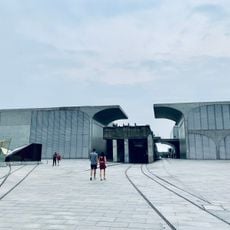
龙华革命烈士纪念地, Memorial site in Xuhui District, Shanghai, China.
The Longhua Revolutionary Martyrs Memorial Site consists of two parts: the former Kuomintang Songhu Garrison Headquarters and the execution ground. The headquarters has a three-story concrete gate tower built in December 1920 with battlements and a watchtower, plus a brick-and-wood prison from 1916 surrounded by a five-meter wall topped with barbed wire. The execution ground is a 1,500-square-meter plot with a monument and a bullet-scarred dead tree.
The site combines the former Songhu Garrison Command headquarters, built as a Jiangnan Arsenal cartridge factory in 1871, with the execution ground beside its 1916 prison. From 1927 to 1937 up to 9,000 people were held there and 800 shot, among them Chen Yannian, Luo Yinong, Zhao Shiyan, Peng Pai and Yang Yin, and the Longhua Twenty-Four Martyrs on the night of 7 February 1931. In 1950 workers dug up 18 complete skeletons at the execution ground; the site became a national key cultural relic in 1988 and opened to visitors in 1991.
The name Longhua comes from the adjacent Longhua area and its temple. In the men's cell block, a poem on the wall reads: "Longhua's ancient wind inspires; heroes die but their will does not end. Peach blossoms outside the wall, blood inside—both equally bright, both equally red." The Longhua Martyrs' Cemetery, merged with the site in 1985, holds the Longhua Martyrs' Memorial Hall, where belongings of executed prisoners are displayed.
The site has two parts: the former Songhu Garrison Command compound with its gate tower and detention cells, and the execution ground 1,500 m² in the northeast corner of Longhua Martyrs Cemetery. The execution ground lies at Lane 2501, Longhua Road; the command post buildings at Nos. 2591 and 2577. The gate tower, guard room, telephone room, offices and men's and women's cells were restored between 1990 and 1991.
A dead tree behind the "Longhua Revolutionary Martyrs' Execution Ground" monument still bears bullet marks; the execution ground itself, a 1,500 m² patch of former wasteland northwest of the old prison, was only pinpointed in 1950 after 18 complete skeletons and some incomplete remains were unearthed there with help from local residents and former inmates.
The community of curious travelers
AroundUs brings together thousands of curated places, local tips, and hidden gems, enriched daily by 93,807 contributors worldwide.