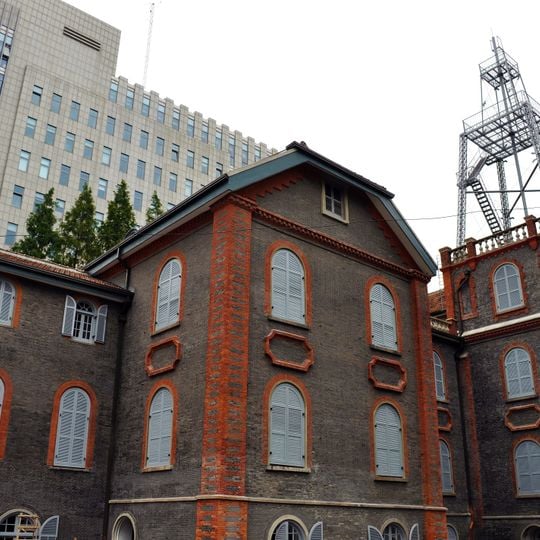
Xujiahui Observatory, Astronomical research center in Xuhui District, Shanghai, China.
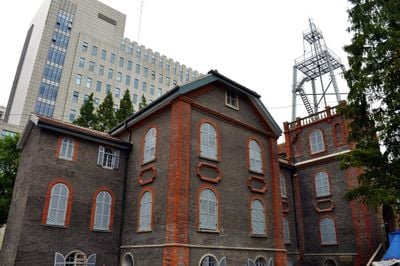
Xujiahui Observatory is a former Jesuit observatory at 166 Puxi Road in Xuhui District, Shanghai, now the Shanghai Meteorological Museum. Its 1901 building is a three-storey, 17-metre brick-and-timber structure in Renaissance style, with a symmetrical facade in three sections, grey and red fair-faced bricks, arched red-brick window frames, hardwood louvred shutters, a double-pitched roof and classical baluster railings on the terrace and outdoor stairs. A brick-and-timber wind tower on the roof was later replaced by an iron one.
The observatory was founded in 1872 by French Jesuit missionaries after the Jiangnan Scientific Committee approved the plan in August that year; astronomical and meteorological observations began on 1 December. A five-bay single-storey building with a two-level platform was erected on Puxi Road in 1873. In 1900 work began on the present building 100 metres west, occupied on 1 January 1901. After 1949 its meteorological work passed to the Shanghai weather service and its astronomy to the Shanghai Observatory.
The observatory's directors were all French Jesuit missionaries; Aloysius Fros, known as the "Typhoon Father", gave his name to Route Père Fros in the old French Concession, today's Hefei Road. The missionaries also studied Chinese science history, compiling ancient earthquake and sunspot records and reviewing works such as the Yixiang Kaocheng. The site is now the Shanghai Meteorological Museum, open free of charge within the Xujiahui Origin scenic area.
The 1901 building stands at 166 Puxi Road in Xuhui, and since 2013 it has housed the Shanghai Meteorological Museum, open free of charge for limited hours as part of the Xujiahui Origin scenic area. The thermometer screen on the lawn in front of the entrance still records the city's daily maximum and minimum temperatures.
The building's lawn still holds a Stevenson screen whose readings give Shanghai's official daily maximum and minimum temperatures. The 1901 facade alternates grey and red brick, with arched red-brick window frames and hardwood louvred shutters; a brick-and-timber wind tower on the roof was later replaced by an iron one.
The community of curious travelers
AroundUs brings together thousands of curated places, local tips, and hidden gems, enriched daily by 94,001 contributors worldwide.