Longhua Pagoda, Ancient Buddhist pagoda in Xuhui District, China
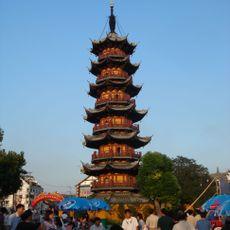
Longhua Pagoda is a seven-story octagonal brick-and-wood tower in Xuhui District, Shanghai, standing 40.64 meters tall. Each of its seven levels has four arched doorways alternating with four rectangular niches, and the direction of these openings shifts 45 degrees from one story to the next. Inside, a hollow brick core with wooden floors and stairs rises to the seventh story, where an 18-meter central pillar runs up into the finial.
The structure originated in 977 during the Northern Song Dynasty and stands as one of the oldest surviving religious buildings in southern China. Its existence spanning more than a thousand years makes it an important witness to Chinese architectural history.
The structure displays classic Chinese architectural features such as extended eaves and intricate wooden joinery crafted by artisans of its era. The relics housed within and traditional artistic forms continue to hold meaning for visitors and believers today.
The pagoda has been closed to the public since 1949 for conservation; only brief, limited openings have occurred, such as in September and October 2006, when groups of ten could visit the first five floors for about 20 minutes. The wooden stairs make high heels unsuitable. Longhua Road now separates the pagoda from Longhua Temple, so the two stand on opposite sides of the street.
In 1966 Red Guards tied ropes to the pagoda and tried to pull it down with a tractor; when that failed they attempted to burn it with petrol, and local residents stopped them. Days later, huge Cultural Revolution banners hung from top to bottom on its south, north and west sides, and the pagoda survived the campaign undamaged.
The community of curious travelers
AroundUs brings together thousands of curated places, local tips, and hidden gems, enriched daily by 93,779 contributors worldwide.