Longhua Temple, Buddhist temple in Xuhui District, China
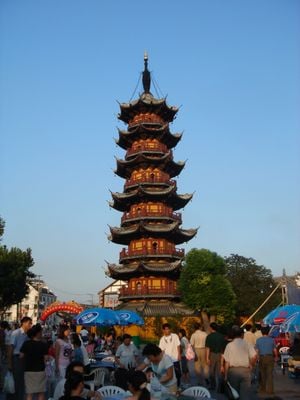
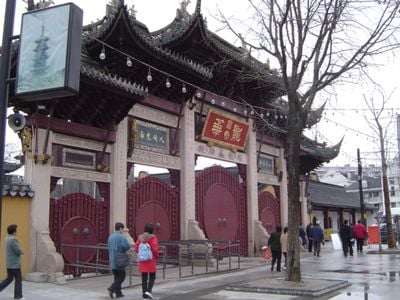
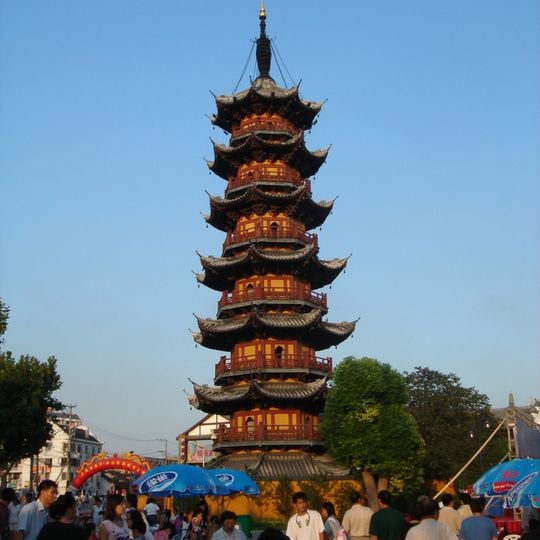
Longhua Temple is a large Buddhist complex in Xuhui District with several main halls arranged along a central axis, including the Maitreya Hall and Mahavira Hall. The site features a seven-story octagonal pagoda and traditional Chinese gardens that, together with various religious structures, form a coherent architectural ensemble.
Longhua Temple was first built in 242 AD during the Three Kingdoms period, when Sun Quan of Wu is said to have ordered 13 pagodas to house Buddha relics. Destroyed at the end of the Tang, it was rebuilt in 977 under Wuyue, renamed Kongxiang Temple in 1064, and regained its name in the Ming Wanli era. The present halls were rebuilt under the Tongzhi and Guangxu emperors, with a full restoration in 1954.
The temple's name comes from a local legend of a dragon appearing on the site, and it is dedicated to the Maitreya Buddha. On New Year's Eve the copper bell cast in 1382, kept in the Bell Tower, is struck in the Evening Bell-Striking Ceremony. The Mahavira Hall holds a bell from 1586, during the Wanli era.
The temple is open daily for visitors to explore the halls, gardens, and grounds at their own pace. Visiting outside the Lunar New Year period offers a quieter experience compared to the crowded celebrations.
The Evening Bell-Striking Ceremony takes place on New Year's Eve in the Bell Tower, using a copper bell cast in 1382. The bell stands 2 metres tall, measures 1.3 metres across at its widest and weighs 5,000 kilograms. The temple's Chinese sources instead date the bell to the 20th year of the Guangxu reign (1894).
The community of curious travelers
AroundUs brings together thousands of curated places, local tips, and hidden gems, enriched daily by 92,796 contributors worldwide.