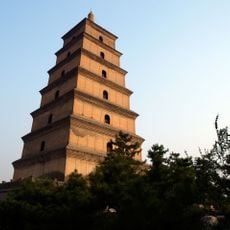
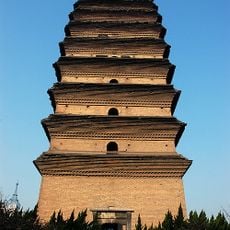
Pagoda of Huayan Temple, Buddhist pagoda in Weiqu Subdistrict, Xi'an, China
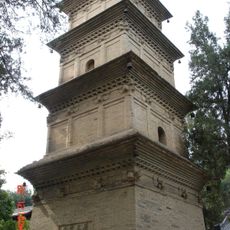
The Pagoda of Huayan Temple consists of two Tang-dynasty brick pagodas on the Shaoling Plateau in Chang'an District, Xi'an. The Du Shun Pagoda is square, seven storeys and 22.8 m high, with a small chamber and south door on the ground floor. The Chengguan Pagoda is hexagonal, seven storeys and 14.2 m high, and was moved 10 m northeast in 1986–87.
The Huayan Temple was founded during the Tang Zhenguan era and was one of the eight great temples of Fanchuan, the birthplace of the Huayan school. The temple was destroyed by a landslide during the Qianlong period of the Qing dynasty, leaving only two brick pagodas standing. The Du Shun pagoda was built in 642, while the Chengguan pagoda was rebuilt in 1272 and moved 10 metres northeast in 1986 after another landslide.
The site is the birthplace of the Huayan school, founded by Dushun, whose tomb pagoda of 642 stands beside that of Chengguan, the fourth patriarch. The temple itself was destroyed by a landslide in the Qianlong era, leaving only the two brick pagodas. A jade vase with five-coloured relics was found in Chengguan's pagoda base during its 1986 move.
The two brick pagodas stand on the Shaolingyuan loess terrace in Sifu Village, Weiqu Subdistrict, Chang'an District. The ground between them is uneven and slopes, so wear sturdy shoes. The Dengshun pagoda has a small door on its south face; the Chengguan pagoda is solid and cannot be entered.
The Qingliang Guoshi pagoda was moved 10 m to the northeast in 1986 after a landslide; the work finished the next year. Inside the base of its sumeru pedestal workers found a jade vase holding five-coloured relics, and Buddhist scriptures and statues from the early Qing period came to light in the second to fourth storeys.
The community of curious travelers
AroundUs brings together thousands of curated places, local tips, and hidden gems, enriched daily by 94,123 contributors worldwide.