Haus Graven, Moated castle in Wiescheid, Langenfeld, Germany
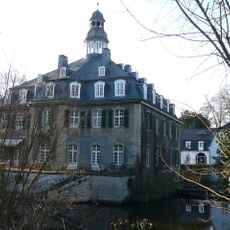
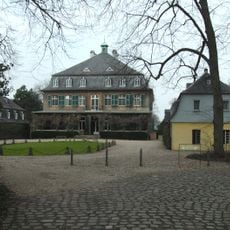
Haus Graven is a U-shaped rubble-stone water castle in Langenfeld-Wiescheid, surrounded on three sides by broad moats. The surviving building is the 17th-century outer bailey (Vorburg), whose corners project as square towers with pyramidal roofs. Above the portal, an alliance coat of arms dated 1656 refers to the families von Velbrück and von den Reven. The main house, the Herrenhaus, once stood southeast of the entrance gate and was demolished in 1790, probably because it was dilapidated.
Haus Graven was probably built around 1300 as a successor to the Motte Schwanenmühle, 800 metres to the north. The name Graven first appears in a document in 1326, and as a place name in 1341. The surviving U-shaped outer bailey was rebuilt in the 17th century, possibly after damage in the Thirty Years' War; the main house was demolished in 1790. The Mirbach-Harff family owned the castle for almost 200 years until 1974.
The Förderverein Wasserburg Haus Graven, founded in 2009, uses the castle for cultural events under a contract with the city. It has set up a permanent exhibition on the castle's history in a tower room. Since 2021 the castle has also housed Langenfeld's environmental education and climate protection centre.
The site welcomes visitors on weekends and holidays, and it is wise to check opening times before your visit. The location at Graf-von-Mirbach-Weg is straightforward to find.
The castle's name first appears in 1326 as a personal name: a squire, Adolf vam Graven, witnessed a contract. As a place name it is documented in 1341, when Adolf vamme Graven granted the Cologne archbishop Walram von Jülich an annual rent from his mill at Graven in the Richrath parish. The water castle itself was never a fief.
The community of curious travelers
AroundUs brings together thousands of curated places, local tips, and hidden gems, enriched daily by 93,630 contributors worldwide.