Ostenfriedhof Dortmund, cemetery in Innenstadt-Ost, Dortmund, Germany
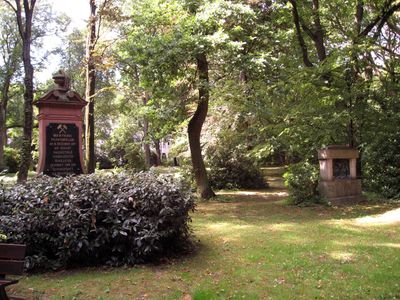
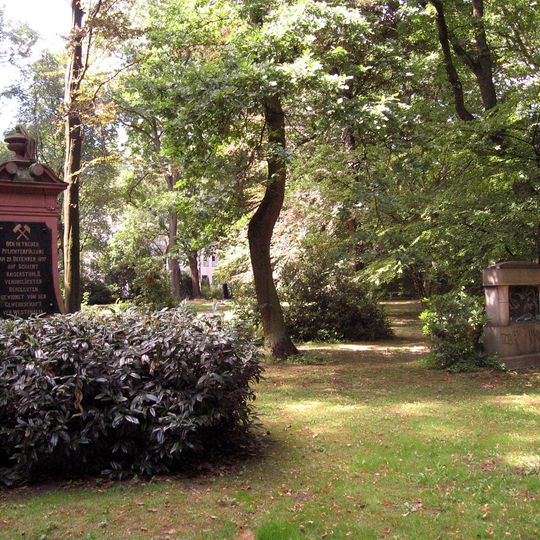
Ostenfriedhof is a 16-hectare burial ground in Dortmund featuring shaded tree-lined pathways, memorial structures, and administrative buildings spread across the grounds. Hundreds of carefully designed grave monuments display craftsmanship from different periods throughout the site.
Dortmund's second municipal cemetery opened on 1 April 1876, when the city's population had risen from about 4,000 in 1811 to over 50,000. Field 14 was used for Jewish burials from 1898, with 14a for adults and 14b for children. After severe bomb damage in the Second World War, the grounds were restored and extended with fields 24 to 28 between 1950 and 1955.
The cemetery's name comes from its location east of the old town, and locals also call it Ostpark. On field 16 stands Benno Elkan's 1909 winged angel on the Röttgers family grave, holding a plaque quoting Ludwig Jacobowski: "Dem Auge fern, dem Herzen ewig nah" (far from the eye, forever near the heart). Elkan, a Jewish sculptor from Dortmund, made many of the grave sculptures here.
The grounds are located near Robert-Koch-Straße and offer well-marked pathways for walking through different sections of the site. Visitors should allow ample time to explore since the grounds are spacious and best experienced on foot.
Field 14 became the Jewish section in 1898, with 14a reserved for adults and 14b for children; three direct bomb hits in World War II struck this small area, and what the bombs spared was looted. After 1945 the city levelled the two row fields, sowed grass and laid new paths as Wiedergutmachung, and a memorial to Dortmund's Jewish victims of the Nazi regime stands beside them. Jewish burials here were restricted from 1936 and stopped in 1943.
The community of curious travelers
AroundUs brings together thousands of curated places, local tips, and hidden gems, enriched daily by 94,505 contributors worldwide.