Enz Viaduct, Railway bridge in Vaihingen an der Enz, Germany
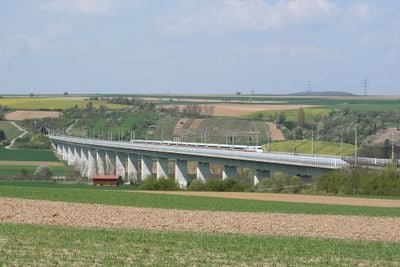
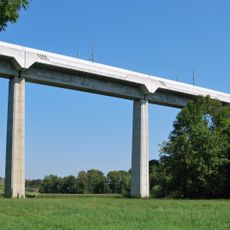
The Enz Viaduct is a railway bridge made from prestressed concrete that crosses over the Enz River valley between Mannheim and Stuttgart. Its structure uses tall concrete supports and long beam sections designed to carry heavy train loads across the entire valley span.
Planned in 1973 at about 1.2 km long and up to 60 m high, the bridge was reduced to roughly 1000 m by 1977. Construction began in September 1986 after numerous objections, and the bridge opened in 1989 at a cost of about 14 million euros. In July 1987, foundation work uncovered a Frankish-Alemannic burial field from the 6th/7th century, prompting rescue excavations that altered the construction schedule.
The bridge crosses fields near the Leinfelder Hof east of Vaihingen an der Enz; the Enz, the K 1685 road and a local recreation area lie beneath it. During foundation work in July 1987, a Frankish-Alemannic burial ground from the 6th/7th century was uncovered and rescued, which changed the construction schedule.
The best times to visit and photograph the structure are early morning or late afternoon when light reaches across the valley. You can view it well from nearby walking paths that run along the river and surrounding areas.
The bridge's 18-span deck was cast in a field factory at the Stuttgart abutment and pushed across the valley in steps of half a span, reaching the Enz between piers 10 and 11 in March 1988. During the push, the joints between sections were made rigid. The span width was raised from the standard 44 m to 58 m to keep the valley view open.
The community of curious travelers
AroundUs brings together thousands of curated places, local tips, and hidden gems, enriched daily by 94,342 contributors worldwide.