Wissower Klinken, chalk cliff formation in Sassnitz, Germany
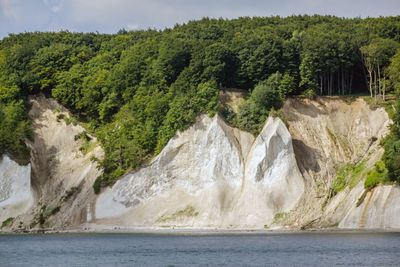
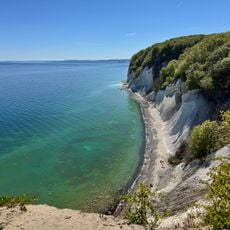
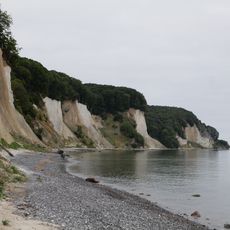
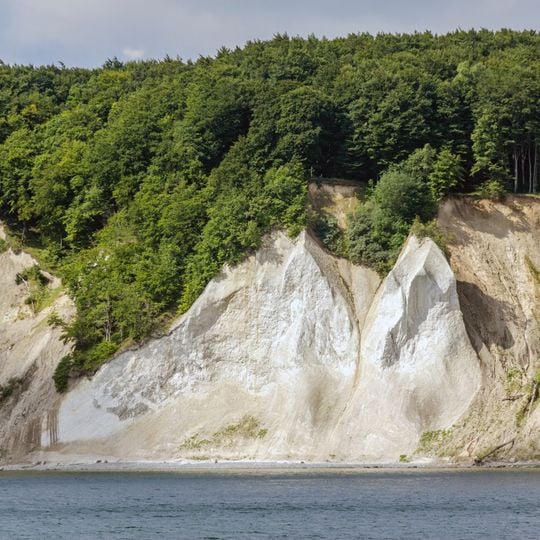
Wissower Klinken is a chalk cliff in Jasmund National Park on Rügen, showing two rounded white buttresses split by a vertical gully, with sandy-beige lower slopes and grey rubble at the shore. The 2005 collapse removed the two main pinnacles, up to 20 metres high, leaving only a remnant of the original formation.
The Wissower Klinken arose after the last ice age: pressure from inland glacial deposits and freezing meltwater cracked the chalk, and the two main pinnacles stood up to 20 metres high. Six cracks were found in 2004, and about 1,000 cubic metres fell a week before 24 February 2005, when some 50,000 cubic metres of chalk slid into the Baltic. Another collapse on 27 July 2010 dropped about 150 tonnes of earth onto the beach.
The name Klinken derives from the Slavic klinŭ, meaning corner or wedge, describing the shape of the former pinnacles. The formation is often wrongly said to be the model for Caspar David Friedrich's painting Chalk Cliffs on Rügen; it did not yet exist when he painted it and arose later through erosion. The site is the third 3D model presented in the DGGV's 30 Geotope³ initiative.
The site is reached through a hiking trail that passes through beech forest with moderate difficulty and clear markings. Wear sturdy shoes and stay on marked paths, as the soft chalk continues to erode and the ground can be unstable near the cliff edge.
The cliff was documented by the German Geological Society as part of the Geotope³ Initiative, serving as a case study for mapping rock movement and erosion in three dimensions. This scientific work demonstrates how digital surveying helps track the rapid changes happening to the coastal landscape.
The community of curious travelers
AroundUs brings together thousands of curated places, local tips, and hidden gems, enriched daily by 92,789 contributors worldwide.