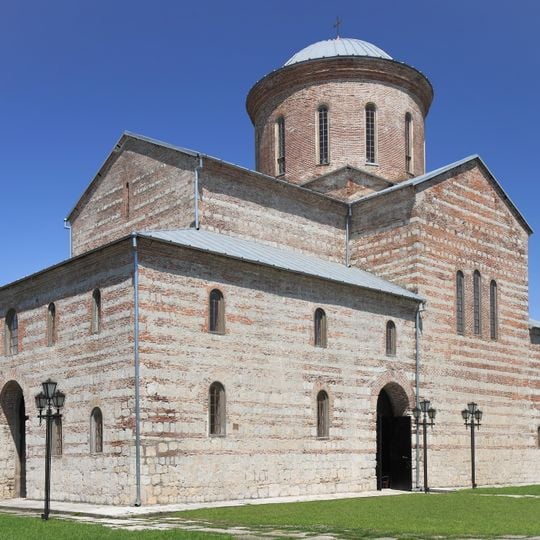
Pitsunda Cathedral, Eastern Orthodox cathedral in Pitsunda, Georgia.
Pitsunda Cathedral is an Eastern Orthodox church in the coastal settlement of Pitsunda, Georgia, built on a cross-shaped plan with three internal aisles and three semicircular apses. The outer walls are made of alternating layers of stone and brick, giving the building a clearly striped appearance.
A basilica stood here in the 4th century, served by Bishop Stratophilus, who took part in the Council of Nicaea in 325. Justinian I had a new church built in the 6th century, and by 541 it held a bishop's seat where the first baptism of Abkhazians took place. The present cross-domed cathedral was built at the end of the 10th century under King Bagrat III of Georgia and served as the seat of the Georgian Orthodox Catholicate of Abkhazia until the late 16th century, when Ottoman rule pushed the Catholicos to Gelati. It was reconsecrated in 1869, after Abkhazia had joined the Russian Empire.
The cathedral is named for St. Andrew the Apostle, and its western part holds a burial vault with two tombs said to be those of Andrew and Simon the Canaanite, marked by frescoes of the two apostles. A 12th-century Georgian manuscript of the Four Gospels, found here in 1830, is now kept in Tbilisi.
The grounds sit within a protected cultural area on the coast and are open to visitors daily. The site is exposed to sun, so comfortable shoes and some sun protection make the visit easier.
The church houses a pipe organ made in Germany that was installed in the 1970s and is still played during concerts today. This makes the building one of the few Orthodox churches in the region where classical music performances take place on a regular basis.
The community of curious travelers
AroundUs brings together thousands of curated places, local tips, and hidden gems, enriched daily by 93,156 contributors worldwide.


