Krubera Cave, Solutional cave in Arabika Massif, Georgia
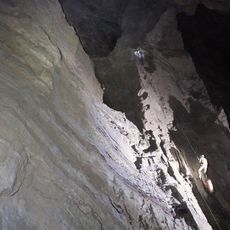
Krubera Cave is a subvertical karst cave in the Arabika Massif, Abkhazia, consisting of a series of shafts connected by galleries. Its main entrance lies at about 2,250 m above sea level in the Ortobalagan Valley; a second entrance, Arabika, opened in 2014, sits 3 m higher. The deepest single drops measure 115, 110 and 152 m, and below 200 m the cave splits into the Nekuybyshevskaya and Main branches. In the photograph, a thin white rope hangs down a narrow shaft of wet brown and grey rock, secured by metal anchors, as a caver in a yellow suit and red helmet ascends through spraying water.
Georgian speleologists led by L. I. Maruashvili of the Vakhushti Bagrationi Institute of Geography discovered the cave in 1960 and explored it to 95 m, naming it after karst scholar Alexander Kruber. Krasnoyarsk cavers re-explored it to 210 m in 1968 as "Siberian Cave", and Kyiv cavers reached 340 m in 1982–1987 under the name Voronya. After the 1992–1993 war work resumed in 1999; the Ukrainian Speleological Association passed 2,000 m in October 2004, and a 2014 Moscow State University ascent opened the Arabika entrance 3 m higher.
The cave has carried three names: Georgian cavers named it for geographer Alexander Kruber in 1960, Krasnoyarsk cavers called it Sibirskaya in 1968, and Kyiv cavers named it Voronya, Crows' Cave, after the crows nesting in the entrance pit. Only an exchange between clubs revealed they were the same cave.
The main entrance sits at about 2,250 m above sea level in the Ortobalagan Valley, and a second entrance opened in August 2014 lies 3 m higher. The cave is a subvertical series of shafts linked by galleries, with the deepest single drops of 115, 110 and 152 m. Below 200 m it splits into the Nekuybyshevskaya branch and the Main branch, and more than eight sumps lie between 1,400 and 2,144 m.
Five eyeless arthropod species were first described from the cave, among them the springtail Plutomurus ortobalaganensis and the amphipod Kruberia abchasica. The deepest parts, below 1,600 m, run through black limestone. Cavers named the entrance pit Voronya, Crows' cave, after the crows nesting there.
The community of curious travelers
AroundUs brings together thousands of curated places, local tips, and hidden gems, enriched daily by 92,656 contributors worldwide.