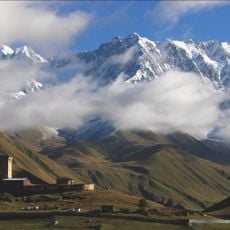
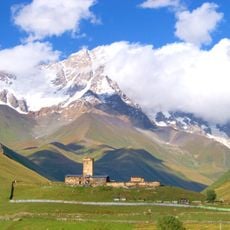
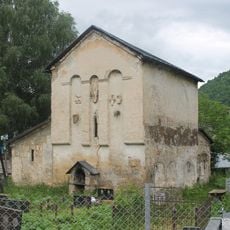
Svanetian tower, Medieval defensive tower in Svaneti, Georgia
Svan towers are stone structures, either freestanding or attached to houses, usually 20–25 metres tall with 4–5 storeys, rarely 6. The lowest floor has walls up to 1.5 metres thick and is mostly windowless, with the entrance at second-floor level. Walls taper to 0.7–0.8 metres at the top, which ends in a crown with a battlement and a two-pitched roof. Built of river stone, boulders and slate, they are fitted with embrasures.
Most Svan towers were built between the 9th and 12th centuries, during the Georgian Golden Age, though their origins likely reach back to prehistory. Around 3,500 stand in Svaneti. In 1996 the Upper Svaneti region, including Ushguli's Chazhashi reserve with over 200 towers, was inscribed on the UNESCO World Heritage List.
Families lived together in these towers and stored their most precious possessions and religious objects within them. The way these buildings are organized still shows how important clan identity was to the Svan people.
Access between floors happens via narrow wooden stairs and ladders, so wear sturdy shoes and be careful as you climb. The spaces are tight and dim, so allow extra time and watch your step on uneven surfaces.
The Ushguli community's Chazhashi reserve holds over 200 towers, and in 2011 the stone architecture received the International Award Architecture in Stone's "Folk Architecture" prize. A modern reconstruction stands near Tbilisi in the Open Air Museum of Ethnography, above Turtle Lake behind Vake Park.
The community of curious travelers
AroundUs brings together thousands of curated places, local tips, and hidden gems, enriched daily by 93,195 contributors worldwide.