Viaduct of Veszprém, Arch bridge in Veszprém, Hungary
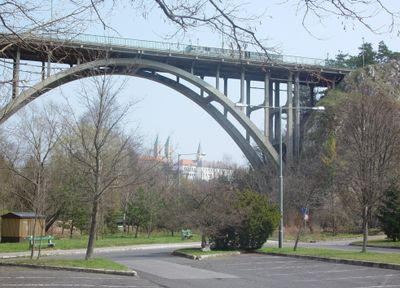
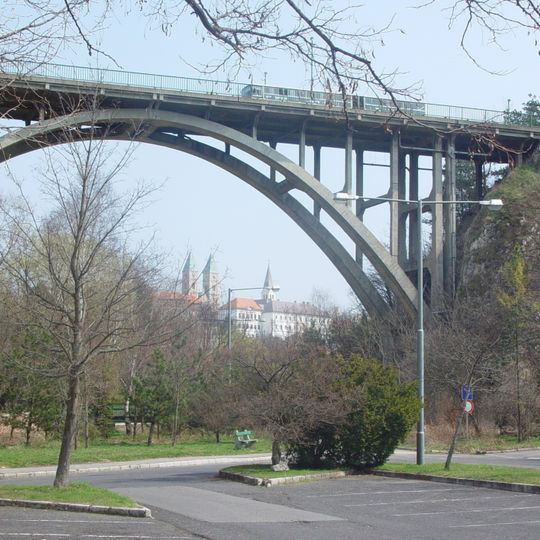
The Viaduct of Veszprém is a reinforced-concrete arch bridge with three spans: a main arch of 46 metres and two smaller arches of 26.6 metres each, carrying a two-lane roadway between the Jeruzsálemhegy and Temetőhegy hills. Its total length is 185 metres and its greatest height 37 metres. A lookout terrace sits where the main arch meets the central small arch, with steps leading down into the Séd valley.
Built in 1936–37 to the design of Róbert Folly, the viaduct carried main road 8 between Székesfehérvár and Rábafüzes. In 1938 it was named after King Stephen I on the 900th anniversary of his death. After 1949 it was recorded as Veszprém Valley Bridge and in 1951 as Mátyás Rákosi Valley Bridge; in 1988 it regained its original name.
The structure is named after Saint Stephen, Hungary's first king, showing how public works connect to national pride. For locals, it serves as an everyday landmark that ties the city together and marks important neighborhood boundaries.
The viaduct forms part of main road 8 and carries daily vehicle traffic connecting different areas of the city. Pedestrians can view it from various angles, particularly from trails in the valley below or from near the Castle District above.
The bridge's popular name, Viadukt, was earlier used for a different structure: the railway bridge over today's Budapest út, demolished in 1972. The name Nagyhíd also came from elsewhere, originally denoting the concrete road bridge on Jókai utca. The bridge's own official names changed repeatedly, from Szent István Völgyhíd in 1938 to Rákosi Mátyás Völgyhíd in 1951.
The community of curious travelers
AroundUs brings together thousands of curated places, local tips, and hidden gems, enriched daily by 94,218 contributors worldwide.