Szentgál Rockhole, Natural cave in Szentgál, Hungary.
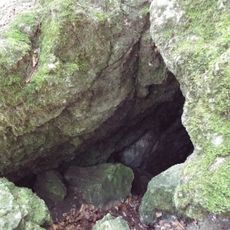
Szentgál Rockhole is a 420 m long, 39 m deep cave in Upper Triassic Hauptdolomit on the northwest slope of Mecsek-hegy above Szentgál, 370 m above sea level. Its southwest-facing entrance, 4.2 m wide and 2.5 m high, is a partly collapsed rock overhang closed by a metal door with a bat opening. Passages are mostly narrow, high fissures along fractures, with small collapse chambers where fracture lines cross.
Evidence from archaeological finds near the site shows that people lived in the Szentgál area since prehistoric times. Human settlement continued throughout different periods of Hungarian history.
The cave appears in print under many names: Dornyay Béla described it as Kőlik in his 1927 Bakony guide, and later works list Mecsekhegyi Kőlik, Mecsek-hegyi-kőlik and Szentgáli Kőlik. Excavations from 1985 by the Heliktit cave research group found Copper Age potsherds, Bronze Age urns, Roman coins and Árpád-era pots.
The cave is locked; entry requires a permit from the Balaton Uplands National Park Directorate, and visits are not allowed during the bats' winter rest period. It is reached from Szentgál centre by about 1 km on the red-marked trail, then a very steep path just over 100 m long. Basic caving equipment is needed to move through the passages.
The cave's stalagmites and stalactites are still growing today, and some dripstone columns reach half a metre in height and the thickness of an arm — rare in a cave formed in dolomite. The Heliktit Cave Research Group began exploring the then-unremarkable cavity in 1985 and multiplied its passage length.
The community of curious travelers
AroundUs brings together thousands of curated places, local tips, and hidden gems, enriched daily by 92,641 contributors worldwide.