Djouce, Mountain summit in County Wicklow, Ireland
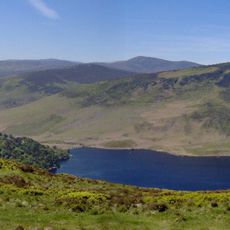
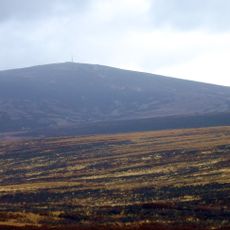
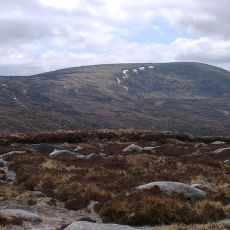
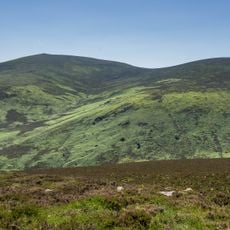
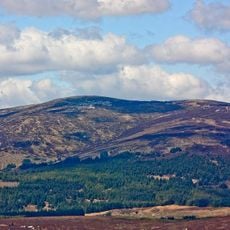
Djouce is a 725-metre mountain in the northeastern Wicklow Mountains, the 74th-highest peak in Ireland on the Arderin scale. Its southern and eastern flanks are planted with Sitka spruce up to and above the 2,000-foot contour, and its southern shoulder is White Hill at 630 metres. A boarded trail of old railway sleepers, laid by the Office of Public Works in 1997–1999, runs from Ballinastoe Wood toward the summit slopes.
Djouce takes its name from the Irish 'Dioghais', meaning fortified height, though Paul Tempan notes the old word 'dígas' was already unclear when a 'Sliab Digsa' appeared in the 12th-century Metrical Dindshenchas, where the second element reads as a woman's name. The mountain is also recorded as Dowse in historical sources. In 1946 a Junkers Ju 52/3m carrying 21 girl guides crashed on its south-western slopes; all 27 on board survived.
The name comes from the Irish word 'Dioghais', meaning fortified height, which reflects the area's historical significance. A memorial stone on the southern slopes honors J.B. Malone, who created the Wicklow Way walking trail that draws many visitors to this region.
The climb follows a well-maintained boarded trail made from railway sleepers that protects the underlying bog from erosion and foot traffic. The path is straightforward to follow, especially important during wet weather when the timber steps reduce slipping hazards.
In 1946, a Junkers aircraft carrying girl guides crashed on the southwestern slopes, but all occupants survived the impact. The incident left traces of aviation history on this remote mountain, marking an unexpected chapter in the peak's past.
The community of curious travelers
AroundUs brings together thousands of curated places, local tips, and hidden gems, enriched daily by 94,476 contributors worldwide.