Maresha, Archaeological site in Southern District, Israel
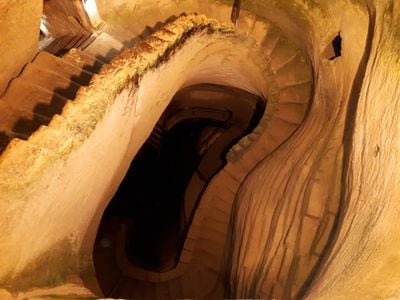
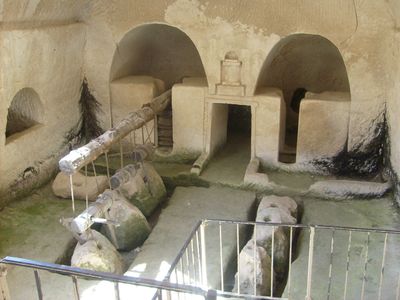
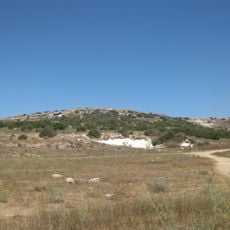
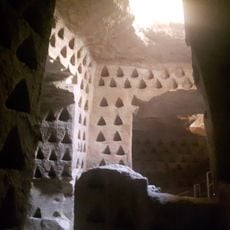
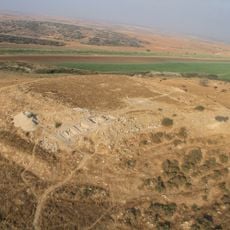
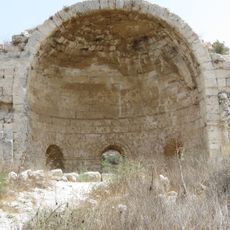
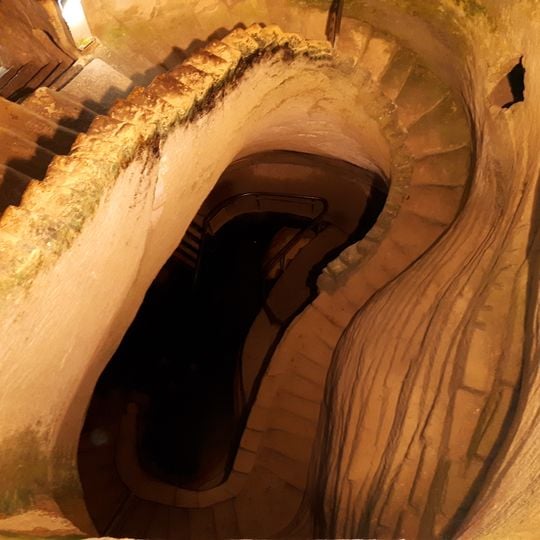
Maresha is a tell of about 24 dunams in the Shephelah, with a lower city of some 400 dunams around it. Its pale beige limestone holds a spiral staircase cut as rough irregular blocks around an open shaft, and a rock-cut complex with two rounded archways, a stepped block bearing an incised motif, and rectangular basins divided by low ridges.
The site developed when Greek influence reached the region, becoming an important urban center from the 4th to 2nd century BCE. The underground structures and artifacts show that the settlement supported a thriving economy based on agriculture, trade, and craft production over several centuries.
Maresha was a bilingual city, Greek and Aramaic, with a mainly Idumaean identity. The Sidonian burial cave of Apollophanes, head of the Sidonian community, preserves wall paintings and a Greek love graffiti; names there mix Greek, Phoenician and Idumaean, showing gradual Hellenisation. The Heliodorus inscription of 178 BCE, 23 lines in Greek, records a Seleucid appointment.
The site lies in Beit Guvrin-Maresha National Park, about 1.5 km south of Beit Guvrin, and is reached on foot along paths and staircases cut into the rock. The stepped shaft and the underground chambers descend into deep shadow, so carry a torch and watch the carved steps, which are rough and irregular. Sturdy shoes help on the uneven limestone.
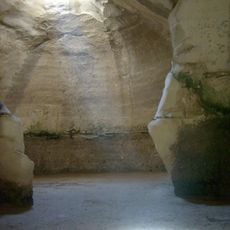
Hidden beneath the site are hundreds of carved caves that served unexpected purposes, including pigeon breeding operations where birds were raised for meat and their droppings collected for fertilizer. This ingenious practice reveals how residents maximized their limited resources.
The community of curious travelers
AroundUs brings together thousands of curated places, local tips, and hidden gems, enriched daily by 92,722 contributors worldwide.