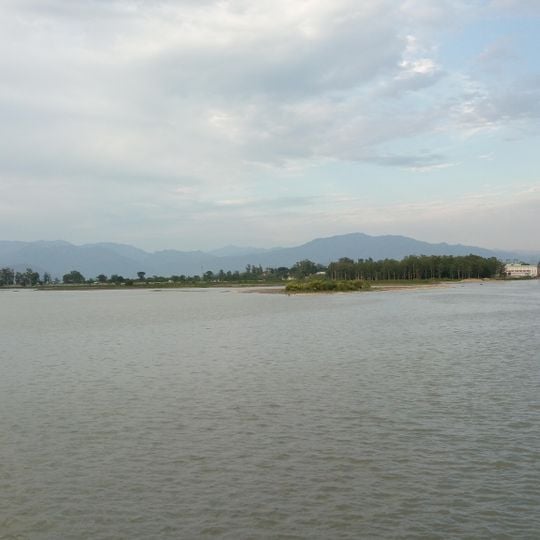
Asan Barrage, Water barrage in Dehradun district, India
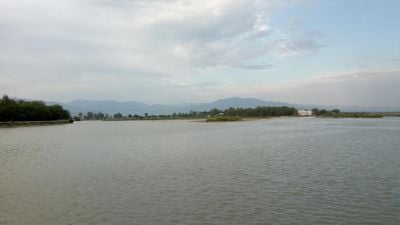
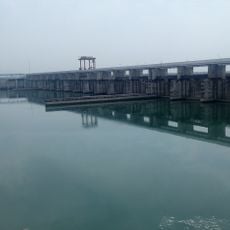
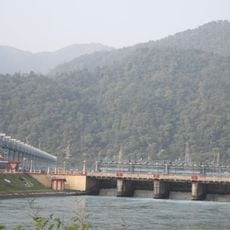
Asan Barrage spans approximately 287 meters at the confluence of the Asan River and Eastern Yamuna Canal in Uttarakhand. Water channeled through it flows to the Kulhal Power Plant, which generates electricity using three turbine units.
The Asan Barrage was built at the meeting point of the Asan River and the Eastern Yamuna Canal, and its reservoir, Dhalipur Lake, was established as a bird sanctuary in 1967. Water released behind the barrage runs 4.5 km down the canal to the 30 MW Kulhal Power Plant, whose three 10 MW Kaplan turbine-generators work with a design head of 18 m. In 2020 the wetland became Uttarakhand's first Ramsar site.
The reservoir behind the barrage, Dhalipur Lake, is known for birdwatching: 53 species have been recorded there, 19 of them migratory birds from Eurasia. The wetland was established in 1967 where the Yamuna and Asan rivers converge, and boating is offered alongside birdwatching.
The barrage stands about 28 km northwest of Dehradun and 11 km from Dakpathar, at the meeting point of the Asan River and the Eastern Yamuna Canal. Birdwatchers come between October and December and from mid-March to the end of April. Boating is also offered at the reservoir.
The Asan River feeding the barrage has been identified with the Asmanvati mentioned in the Rigveda, and its northern stretch is locally called the Tons, though the real Tons is a different, larger river. The reservoir behind the structure is also known as Dhalipur Lake.
The community of curious travelers
AroundUs brings together thousands of curated places, local tips, and hidden gems, enriched daily by 92,785 contributors worldwide.