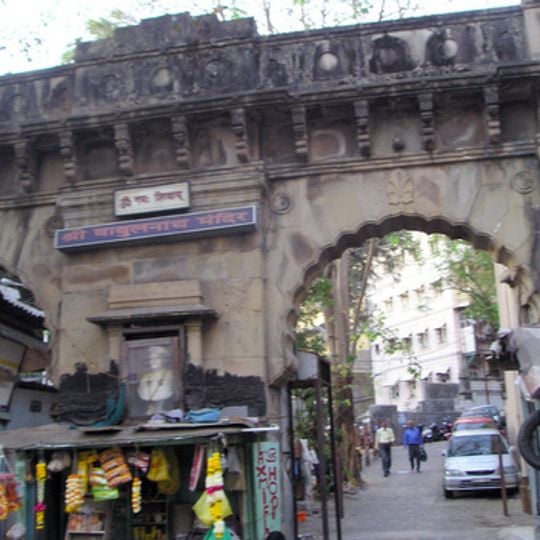
Babulnath, Hindu temple in Mumbai, India
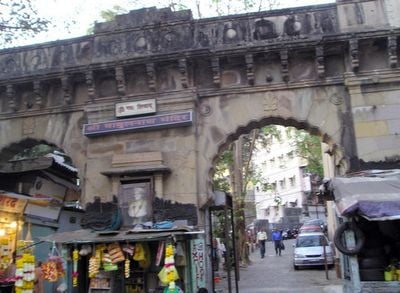
Babulnath is a Hindu temple dedicated to Shiva on a small hillock near Girgaum Chowpatty in Mumbai, India. Its current structure dates from 1890, when it was expanded with contributions from Maharaja Sayajirao Gaikwad of Baroda state. A stone gateway with a large pointed arch opens onto a paved lane, with a white sign and a blue sign above the arch.
The Shiva linga and idols were originally consecrated in the 12th century by Bhimdev, the region's Hindu king, but the temple was later buried and lost. It was rediscovered between 1700 and 1780, and the first temple was built in 1780, when five idols were unearthed: the main Shiva linga, Ganesh, Hanuman, Parvati and a fifth that broke during excavation and was immersed in the sea. After a legal dispute with the Parsi landowners settled in the temple's favour in the late 1800s, Maharaja Sayajirao Gaikwad of Baroda funded an expansion in 1890, the date of the current structure.
The name refers to the babul trees that once covered the hill before the shrine was built. Worshippers bring bilva leaves, which they place directly onto the lingam, while priests in saffron robes guide the rituals.
Access is either by a steep stairway or a gentler sloping path, both leading up from the base of the hill. Visitors should wear modest clothing and remove their shoes before entering the inner sanctum.
The temple's present structure dates from 1890, when Maharaja Sayajirao Gaikwad of Baroda state contributed to its expansion, and until the 1980s it ranked among Mumbai's tallest buildings. A lightning strike in the 1960s damaged the spire and cut its height. The five idols unearthed during the 18th-century rediscovery were the Shiva linga, Ganesh, Hanuman, Parvati and one broken during excavation and immersed in the sea.
The community of curious travelers
AroundUs brings together thousands of curated places, local tips, and hidden gems, enriched daily by 94,650 contributors worldwide.