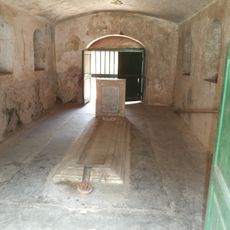
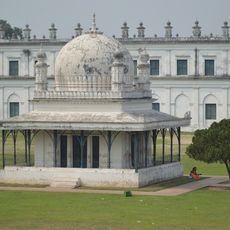
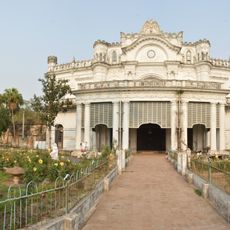
Bachhawali Tope, Historical cannon in Murshidabad, India.
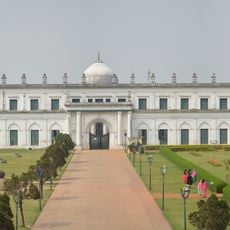
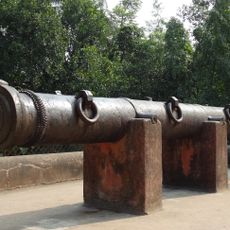
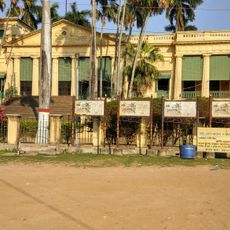
Bachhawali Tope is a cannon displayed on the Nizamat Fort Campus, positioned between the Nizamat Imambara and Hazarduari Palace. The iron barrel features eleven decorative rings and brass lines, with an ornamental opening shaped like flower petals.
The cannon was made between the 12th and 14th centuries, probably by the Muslim rulers of Gaur; some texts credit Janardan Karmakar of Dhaka. It first lay on the sand banks of Ichaganj, guarding Murshidabad against north-western attacks. After the Nizamat Imambara burned in 1846 and was rebuilt, architect Sadeq Ali Khan moved the cannon to its present spot on the suggestion of Sir Henry Torrens, agent of the Governor General.
The name Bacchawali Tope combines Bacchawali, "the one who produces childbirth", and Tope, "cannon". Legend holds that the cannon was fired only once; the blast, heard about 10 miles away, made most of the city's pregnant women give birth. Visitors still hear this story told on the Nizamat Fort Campus.
Access to the cannon is straightforward since it sits on the open Fort Campus grounds and is easily reached on foot. Visitors should allow time to explore nearby structures including the Imambara and Palace, which are all within walking distance.
The cannon's muzzle has a diameter of approximately 1 foot 7 inches and features ornamental details resembling strings of beads. These fine details reveal the craftsmanship of the artisans who created this piece.
The community of curious travelers
AroundUs brings together thousands of curated places, local tips, and hidden gems, enriched daily by 92,754 contributors worldwide.