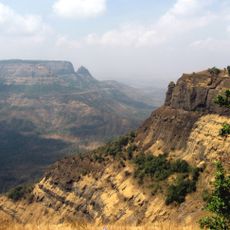
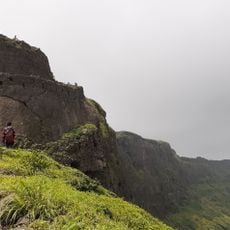
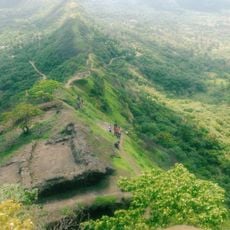
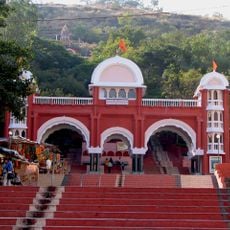
Ghorawadi Caves, Buddhist cave monument in Pune district, India.
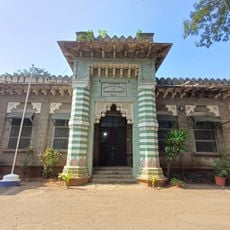
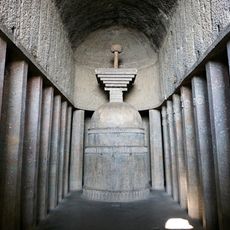
Ghorawadi Caves is a rock-cut complex of nine or ten Buddhist caves carved into a single hill at 450–500 m above sea level, with a chaityagriha and vihara. The chaityagriha, now the Shri Ghorwadeshwar Temple, has a Brāhmī inscription on one wall. Later statues of Vitthal, Rakhumai and Saint Tukaram were installed in a vihara.
The caves were carved from a single rock formation; the English source places this in the 3rd–4th century CE, while the Marathi source dates the nine or ten Buddhist caves to the 1st century BCE–1st century CE. A Brāhmī inscription on a wall records that the chaityagriha was dedicated to the Buddha and the Samgha by the daughters of Dhapar, a disciple of Bhadantsingh. That chaityagriha is now the Shri Ghorwadeshwar Temple, and a Shiva temple was installed in later times.
The name Ghoradeshwar combines the Marathi word for the Indian bustard, ghorad, with Ishwar, lord: a legend says a bustard worshipped the shivalinga here and Shiva granted it a boon. The chaityagriha is now the Shri Ghorwadeshwar Temple, and a large cave holds a shivalinga visited at Mahashivratri. Statues of Vitthal, Rakhumai and Saint Tukaram were installed in a vihara in recent times.
The site sits about 25 kilometers northwest of Pune near National Highway 4, making it reachable for day trips. Visitors should wear sturdy shoes and allow time to explore the chambers at a steady pace.
The name Ghoradeshwar combines the Marathi word ghorad, the Indian bustard, with Ishwar, lord: "Lord of the Bustard". A Hindu legend says that when famine and drought killed the region's birds, a bustard worshipped the cave's shivalinga and Shiva granted it a boon. The shivalinga and the cave are cut from the same rock.
The community of curious travelers
AroundUs brings together thousands of curated places, local tips, and hidden gems, enriched daily by 93,393 contributors worldwide.