Porta Trasimena, city gate in Perugia, Italy
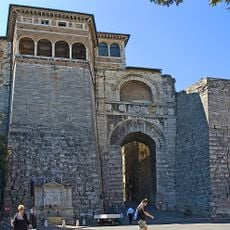
Porta Trasimena is a city gate in Perugia originally built by the Etruscans as part of the city walls and later modified during medieval times. Its semicircular arch was changed into a pointed arch, and a lion sculpture was added above the entrance and remains visible today.
Built in the second half of the 3rd century BC into Perugia's Etruscan walls, the gate opened onto the road to Lake Trasimeno, from which it takes its name. In the 14th century the original round arch was rebuilt as a pointed one, and a lion protome was added to the facade.
The gate's names come from its surroundings: Porta Trasimena from the road to Lake Trasimeno, Arco di San Luca from the nearby church of San Luca, and Porta della Madonna della Luce from the church of that name. On the left side, above a niche, stand a travertine lion and the Roman inscription "AUGUSTA PERUSIA-COLONIA VIBIA".
The gate stands on Via dei Priori, in the upper part of Perugia's historic centre, and can be reached on foot along the street that climbs from the city's lower quarters. It is a public passage, open at all hours, so it can be seen at any time of day. Nearby are the churches of San Luca and della Madonna della Luce, which give the gate its alternative names.
Above the arch sits a carving of a figure with a bow and a half-moon, whose meaning remains mysterious to this day. A Latin inscription reads 'Augustus Perusia - Colonia Vibia' and links the gate to Roman times, though the full significance of these symbols is still debated by historians.
The community of curious travelers
AroundUs brings together thousands of curated places, local tips, and hidden gems, enriched daily by 93,123 contributors worldwide.