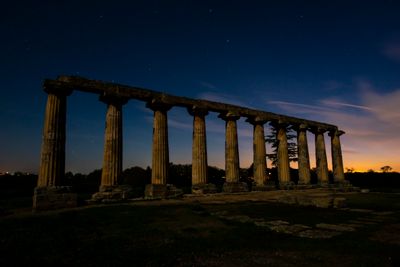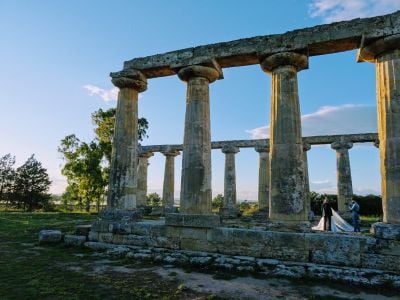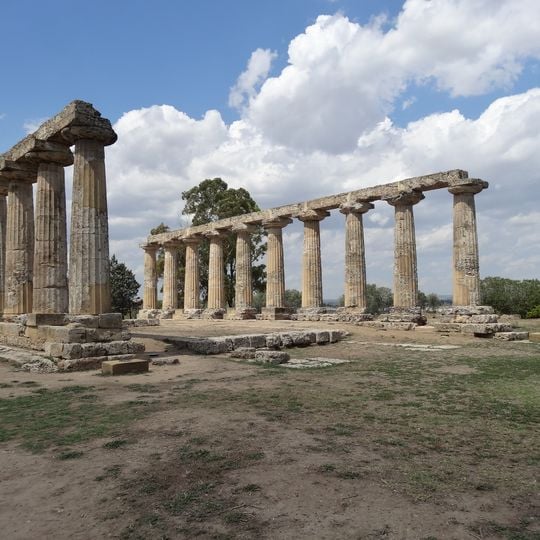
Tavole Palatine, Ancient Greek temple ruins in Bernalda, Italy.
The Tavole Palatine are the remains of a 6th-century BC hexastyle peripteral Doric temple dedicated to Hera, standing on the right bank of the Bradano near Metaponto. Fifteen columns with twenty flutes and Doric capitals survive: ten on the north side and five on the south. The stylobate measured 34.29 m by 13.66 m, and the temple was built of local limestone called mazzarro.
The Tavole Palatine are the remains of a 6th-century BC Doric temple dedicated to Hera, part of an extra-urban sanctuary by the Bradano river about 3 km from Metapontum. It was restored in 1961. A vase fragment found in the 1926 excavations carried a votive dedication to Hera, overturning an earlier attribution to Athena.
The name "Tavole Palatine" likely recalls a past identification with an ancient palace; until the 19th century locals also called the ruins Mensole Palatine or Colonne Palatine, and the temple was known as the Scuola di Pitagora after Pythagoras. In the Middle Ages it was called Mensae Imperatoris, recalling Emperor Otto II, who camped at Metapontum in 982.
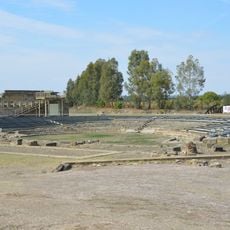
The site is easily accessible and situated on flat terrain, making it manageable for visitors of all fitness levels. There is little shade among the columns, so it is best to visit during cooler weather or earlier in the day to avoid direct sun exposure.
The temple was built over the remains of a Neolithic village, on the line of a prehistoric road from Siris-Heraclea. In the Middle Ages it was called Mensae Imperatoris, probably recalling Emperor Otto II, who camped at Metapontum in 982 during his expedition against the Saracens.
The community of curious travelers
AroundUs brings together thousands of curated places, local tips, and hidden gems, enriched daily by 94,191 contributors worldwide.