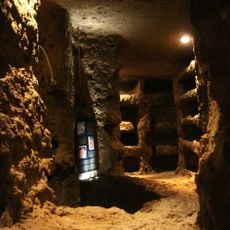
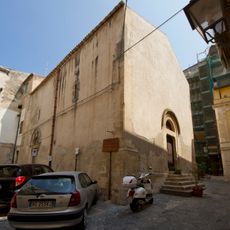
Terme di Dafne, Archaeological remains in Syracuse, Italy.
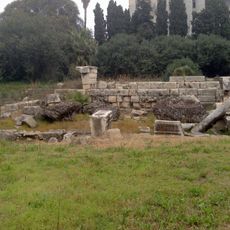
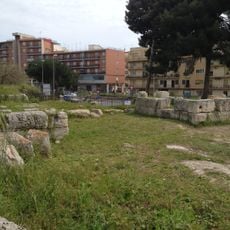
Terme di Dafne is a small Roman bath complex in Syracuse, probably built in the 3rd or 4th century AD and later renovated in Byzantine times. Its northern part has rooms identified as an apodyterium (H), a semicircular frigidarium (G), a tepidarium (E) and a calidarium (C); a semicircular pool (K) lies on the south side. The site was discovered in 1934 by Giuseppe Cultrera and is now largely hidden by 1960s buildings.
The complex is Roman, dated by its masonry to the 3rd or more probably the 4th century AD, with later Byzantine renovations. It was discovered in 1934 by the archaeologist Giuseppe Cultrera, who judged its modest size to indicate a private rather than public bath. The site is commonly identified with the baths where, according to Theophanes, the Byzantine emperor Constans II was assassinated.
The name Dafne links the baths to the myth of Daphne, and the site is commonly identified with the baths where, according to Theophanes, Emperor Constans II was murdered in 668. The rooms keep their interpretive labels: H as apodyterion, G as frigidarium, E as tepidarium, C as calidarium.
The site is located beneath modern apartment buildings in Syracuse's old town, limiting direct access to the underground structures. Check with local sources before visiting to learn about current viewing possibilities.
In 1872 a small hoard of ancient valuables was found near the site, including a heavy gold ring that the scholar Bryce Dale Lyon attributed to Emperor Constans II himself, or to a courtier who hid it during the turmoil after his murder in the baths.
The community of curious travelers
AroundUs brings together thousands of curated places, local tips, and hidden gems, enriched daily by 94,401 contributors worldwide.